

Oil Filtration Systems for Oil & Gas
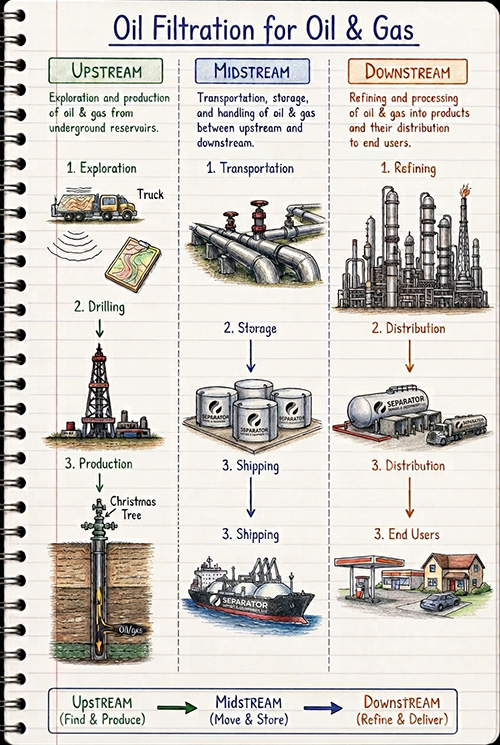
Oil Filtration for Oil & Gas Applications (click to enlarge image)
Oil in oil and gas equipment gets contaminated in four main ways: solid particles (silica, wear metals, scale), water (free, emulsified, and dissolved), chemical degradation products (oxidation, nitration, sludge, varnish), and fluid cross-contamination (fuel dilution or glycol/coolant leaks). No single oil filtration technology removes all four. Oil filtration does not fix fluid cross-contamination; you must repair the root cause (injector, cooler, or head gasket leak). Specifying an oil filtration system starts with identifying which contaminants are actually present, which is what oil analysis is for.
While the core separation and filtration technology is similar to our maritime, mining, data center, and power generation systems, the application differs significantly. Oil and gas equipment is field-deployed, faces severe dust ingress, is constrained by remote logistics, and requires much longer service intervals between site visits.
Why Oil & Gas is Uniquely Hard on Fuel & Lube Oil Systems?
Oil and gas operations push critical drivers to their mechanical limits. Continuous-duty gas compression engines, such as Caterpillar G3600/G3300 series, Waukesha VHPs, and Ariel-driven skids, run 24/7/365 and log thousands of hours between planned stops. Stationed in environments like dusty frac sites, sandy basins, and high-humidity offshore platforms, these remote assets face a double threat: extreme duty cycles and relentless environmental contamination.
The Failure Loop: How Contamination Bypasses Primary Defense
- Abrasive Site Conditions: Unpaved compressor stations, wellheads, and active frac sites load intake air with sand, dust, dirt, and silica. Over time, these hard particulates migrate past the rings via blow-by and enter the crankcase directly.
- Dirty and Wet Field Gas: Unrefined field gas with entrained liquids continuously introduces acid-forming byproducts, moisture, soot, and sludge into the lube system.
- Continuous Soot & Oxidation Build-Up: Without stopping, soot loading, oxidation byproducts, and varnish continuously accumulate in the sump, degrading oil lubricity long before scheduled maintenance.
The Critical Gap in Standard Oil Filtration
Standard full-flow spin-on filters using cellulose media are engineered solely as an emergency shield, capturing large debris down to roughly 35-40 microns (35-40 μm) to prevent immediate, catastrophic failure. They were never designed to capture particles below 10 microns (10 μm) or dissolved liquids. This gap lets sub-micron soot, fine silica, and moisture cycle continuously through the engine, acting like liquid sandpaper on critical components.
- Accelerated Mechanical Wear: Rapidly degrades main bearings, piston rings, and cylinder liners.
- Unplanned Compressor Downtime: Unexpected engine failures directly halt line pressure and cut daily production revenue.
- Shortened Oil-Drain Intervals (ODIs): Premature oil degradation forces frequent, costly lube changes.
- High Logistics & Labor Costs: Sending service technicians and lube trucks to hard-to-access, remote pads drains the operational budget.
A full-flow filter is your baseline, not your complete solution. Fine soot, silica, and water need a second stage, such as a centrifugal bypass, centrifugal separators, coalescer, kidney-loop, separator, or vacuum dehydrator, matched to the contaminant.
CASE STUDY: Waukesha 7042 Engine, South America
- Problem: High soot, silica, and solid contaminants loading forced early drain intervals and accelerated bearing wear on a remote gas compression skid.
- Baseline Oil Analysis: (Pre Installation) TBN 6.61, ISO 4406 19/19/16 Code
- Solution: Upgrade current centrifugal bypass cleaner with IOW Group centrifuge
- Solution Installed: Replaced Microspin centrifuge with IOW MP200 centrifuge
- Result after 2000 hours: (Post Installation) TBN 6.82, ISO 4406 17/16/14 Code
- Estimated Savings: Based on Noria’s Life Extension Table, extended asset life (engine and component) by 1.6 times (1.6x); plus, extended drain intervals.
- Customer Comments: “We run cleaner and run stronger with IOW Group Centrifuges! We cut filter usage and increase our uptime!”
What could better filtration save you? Use our oil filtration ROI calculator to estimate savings for your own equipment. For example, an INNIO Waukesha 7042GSI engine on a 500-hour oil-drain interval consumes roughly 110 gallons (416 liters) of oil per change. If bypass centrifugal filtration extends that drain interval to 1,000 hours, use the calculator to estimate annual savings per engine on oil, filters, and filter disposal, excluding labor and service-truck costs, with a payback period in months. Run your own numbers!
Oil & Gas Filtration Solutions
How to Choose Oil Filtration for Oil & Gas Operations?
 Effective oil filtration in oil and gas starts with a baseline full-flow filter, paired with secondary filtration technologies matched to your specific contamination profile, operating conditions, and target oil cleanliness levels. While bypass and kidney-loop systems capture fine particulates and soot that standard full-flow filtration misses, moisture removal requires matching the separation method to the water state: use coalescers for free water in light fuels, disc-stack centrifuges for heavy solids and free water, or vacuum dehydration for emulsified and dissolved moisture. Layering the right combination of these filtration technologies protects critical components, extends drain intervals, and minimizes unplanned downtime in remote operations.
Oil Filtration and Separation Technologies Compared
| Method | Removes | Does Not Remove | |
| Full-Flow Filter |  | Particles above its rating. Engine and lube filters are commonly rated in the range of roughly 35-40 µm, depending on media and OEM design. Test efficiency per ISO 4548-12 (lube) or ISO 16889 (hydraulic, beta ratio). | Fine particles below its rating, dissolved water, varnish |
| Centrifugal Bypass Cleaner | 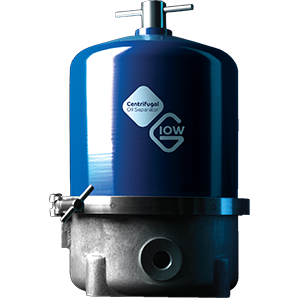 | A portion of fine insoluble solids by centrifugal force, including soot agglomerates and wear debris. Performance depends on rotor speed, flow, and viscosity. | Dissolved contaminants, varnish; it is not a water-removal device |
| Offline (Kidney-Loop) Filtration | 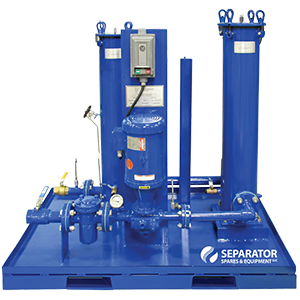 | Fine particles, with elements typically rated to single-digit µm. Water-absorbing elements can remove limited free water. | Dissolved water in quantity, varnish (without specialty media) |
| Coalescer/Separator | 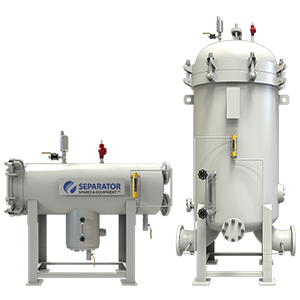 | Free and some emulsified water, mainly in low-viscosity fluids such as fuels and light oils | Dissolved water. Effectiveness drops in oils with heavy detergent/dispersant additive packages, which hold water in emulsion. |
| Disc-Stack Centrifuge | 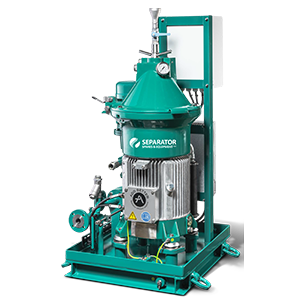 | Free water and solids by density difference. Oil is typically heated to lower viscosity. | Dissolved water, varnish |
| Vacuum Dehydration |  | Free, emulsified, and dissolved water, plus dissolved gases. Confirm compatibility with the fluid. | Particles, unless a filter stage is integrated |
| Electrostatic or adsorbent (Ion-Exchange) Varnish Removal | 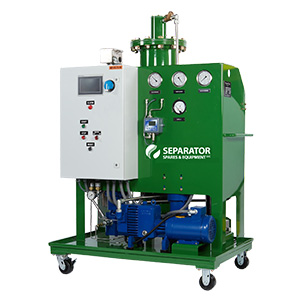 | Varnish precursors and sub-micron soft contaminants that particle filters cannot capture | Bulk water, large particles |
Do you have questions about matching separation systems and oil filtration for oil & gas applications? Send us your latest oil analysis report for a free system sizing review. Let us help you select the right oil filtration system for your application!
Where Oil Filtration Is Used in Oil and Gas Operations?
Nearly every piece of rotating equipment in oil and gas runs on oil, and the oil gets dirty in different ways depending on where the machine sits. A drilling rig fights dust and vibration. A drillship fights moisture and soot. A refinery fights varnish. Matching the filtration to the contaminant matters more than the sector label, so here is how it breaks down.
Upstream: Drilling, Production, and Offshore
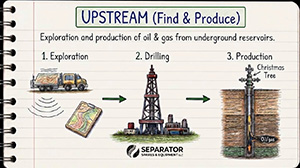 Typical equipment includes gas compression engines, diesel generator sets, hydraulic power units (HPUs), top drives, drawworks, and mud pumps. The oil in these machines is affected differently:
- Diesel Generators and Rig Engines: soot loading, fuel dilution, and water from condensation and combustion by-products.
- Natural Gas Engines: oxidation, nitration, and TBN depletion (alkalinity is used up neutralizing acids). Wet or sour field gas can accelerate acid formation.
- Hydraulic Systems: particles and water. Valve and pump clearances are small, often in the single-digit to low double-digit micron range, so the component manufacturer specifies cleanliness as an ISO 4406 code.
- All Engines: silica enters mainly through the air intake and breathers, not the oil itself. Air filtration and breather maintenance are the first line of defense, and oil filtration handles what gets through.
Offshore and remote sites favor low-maintenance, offline systems, since power, space, and service access are limited.
| Equipment | Typical Contaminants | Typical Filtration Solution |
| Diesel Fuel Supply | Free water, sediment | Coalescer/separator, disc-stack centrifuge |
| Diesel Generator and Rig Engines | Soot, fuel dilution, silica, water | Full-flow filtration + centrifugal bypass cleaner, offline filtration |
| HPUs, Top Drives | Particles, water | Pressure- and return-line filters, offline kidney-loop filtration |
| Mud pumps, Drawworks | Dust, wear debris | Full-flow, offline polishing |
| Natural Gas Engines | Oxidation and nitration products, TBN depletion, silica, ash | Full-flow filtration + centrifugal bypass cleaner, offline filtration |
Midstream: Compression, Pumping, and Storage
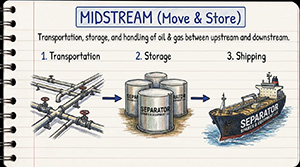 On reciprocating gas compressors, it helps separate two (2) oil systems: (1) frame (crankcase) oil, which is circulated and filtered, and (2) cylinder lubrication oil, which is usually fed once-through by lubricators and not recirculated. Oil filtration applies to the frame oil. Centrifugal compressors and their driving turbines use circulating lube systems with a reservoir, coolers, and (commonly duplex) filters. Contaminants include oxidation products, moisture, and, in turbine and compressor reservoirs, varnish. Varnish is a soft, oil-degradation deposit. Particle filters and particle counts do not capture it, so it is trended with the membrane patch colorimetry (MPC) test, ASTM D7843, and treated with electrostatic or adsorbent systems.
At pipeline pump stations and terminals, strainers and filter vessels protect pumps from rust, pipe scale, and weld debris, particularly after construction or line work. As diesel is stored at terminals or in bulk on-site tanks, water accumulates, sediment settles, and microbial growth can develop wherever water and fuel meet. Without proper management, these contaminants are transferred downstream with the fuel. Water collected in stored fuel and hydrocarbon liquids requires coalescers or separators.
| Equipment | Typical Contaminants | Typical Filtration Solution |
| Bulk Fuel and Diesel Storage | Free water, sediment | Coalescer/separator |
| Pipeline and Transfer Pumps | Scale, rust, sand | Duplex strainers, cartridge filter vessels |
| Reciprocating Compressor Frame Oil | Moisture, oxidation, nitration | Full-flow plus bypass filtration; vacuum dehydration if water persists |
| Turbine Reservoirs and Centrifugal Compressor | Varnish, moisture, particles | Fine filtration, varnish removal, vacuum dehydration |
Downstream: Refining, Petrochemical, and Power
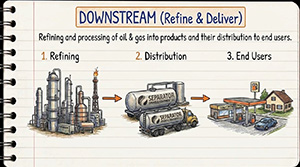 Refineries, petrochemical plants, and power plants use many of the same technologies. Turbine and compressor oil cleanliness and varnish control are the central concerns, and vacuum dehydration and electrostatic cleaners are more common here. To learn more, visit Power Plant Oil Filtration: Optimizing Turbine Reliability.
Large volumes of diesel move through pipelines, storage facilities, and transfer points before reaching the end user. Water and particulates introduced during handling can be carried downstream, affecting product quality throughout the distribution system. The downstream oil filtration systems should be driven by data from your own oil analysis. The equipment OEM and oil supplier should set targets and alarm limits.
While operating environments differ, the need to protect against water and particulates does not. Effective oil filtration systems help preserve fuel quality, protect critical equipment, and support reliable operation throughout the diesel value chain.
| Equipment | Typical Contaminants | Typical Filtration Solution |
| Emergency Diesel Generators | Soot, fuel dilution, microbial growth, free water | Full-flow filtration + centrifugal bypass cleaner, fuel coalescer/water separator |
| Gearboxes & Lube Oil Consoles | Heavy wear metals, water condensation, sludge | High-efficiency offline filtration + coalescing or disc-stack separation |
| Refinery Process Pumps & Compressors | Fine wear particles, pipe scale, process water ingress | Duplex fine cartridge filters + offline kidney-loop polishing |
| Steam & Gas Turbines | Varnish precursors, oxidation by-products, trace moisture | Coalescer/separator, varnish removal, vacuum dehydration |
Not Sure Which Separation Technology Fits Your Equipment?
Send us your latest oil analysis report (or equipment model and operating conditions). Our engineering team will review your contamination profile and recommend a properly sized bypass, coalescing, or disc-stack centrifuge setup.
Oil Contamination and Industry Standards
Use the reference standards below when specifying filter efficiency, target cleanliness codes, and varnish testing in your maintenance program:
| Oil Contamination Concerns | Industry Standard Test |
| Particle Cleanliness | ISO 4406 code via automatic particle count (ASTM D7647, ISO 11500) |
| Water | Karl Fischer (ASTM D6304) |
| Wear Metals, Silica, Additives | ICP elemental analysis (ASTM D5185) |
| Alkalinity and Acidity | TBN (ASTM D2896), TAN (ASTM D664) |
| Soot, Oxidation, Nitration | FTIR trending (ASTM E2412) |
| Varnish Potential | MPC Varnish Potential Testing (ASTM D7843) |
Oil Filtration Solutions We Supply
Separator Spares & Equipment provides cost-effective oil filtration for oil & gas operations that will positively impact your business’ bottom line. ISO oil cleanliness levels and contamination control are vital to a proactive maintenance strategy. We offer a broad range of oil filtration systems designed to remove particles, water, varnish, and other contaminants. We provide oil purification machines, custom flow rate solutions, and expert support.
- Automatic Self-Cleaning Filters: Clean their own elements by automatic backflush, so oil keeps flowing without manual element changes on larger fuel and lube systems.
- Bulk Fuel Filtration: Filters and water separators for storage tanks and transfer lines that remove sediment and free water before fuel reaches engines.
- Centrifugal Bypass Oil Cleaners: Use rotor-driven centrifugal force on a slipstream of engine oil to remove fine insoluble solids such as soot and wear debris.
- Centrifugal Separators: Separate water and solids from fuel and lube oil by density difference; we supply new units, spare parts, and service.
- Coalescers & Water Removal Filtration: Merge fine water droplets so they settle out of fuels and light oils; performance depends on the fluid and its additive package.
- Diesel Oil Filtration: Protects injection systems and engines from particles and water in the diesel supply on rigs, generator sets, and day tanks.
- Disc-Stack Centrifuges: Continuously separate water and solids from oil using stacked conical discs, suited to high-volume fuel and lube oil treatment.
- Electrostatic Oil Cleaners: Use an electrostatic field to collect sub-micron and polar contaminants, including varnish precursors, that particle filters can’t capture.
- Fuel Oil Filtration: Protects injection systems and engines from particles and water in the fuel supply.
- Full-Flow Filtration: Filters all of the oil before it reaches bearings and moving parts, providing baseline protection for engines, compressors, and hydraulic systems.
- Hydraulic Oil Filtration: Pressure-line, return-line, and offline filters that hold hydraulic fluid to the ISO 4406 cleanliness code your pumps and valves require.
- Lube Oil Filtration: Full-flow, bypass, and offline filtration for engine, compressor, and gearbox oil, matched to the contaminants your oil analysis shows.
- Offline Kidney-Loop Systems: A separate pump-and-filter loop that continuously polishes reservoir oil independent of the machine, removing fine particles and, with the right elements, some water.
- Turbine Oil Filtration: Fine filtration, water removal, and varnish control for turbine and compressor-train oil, where cleanliness requirements are tight.
- Vacuum Dehydration Systems: Remove free, emulsified, and dissolved water and entrained gases from oil by heating it under vacuum; used on turbine, hydraulic, and compressor oil.
Oil Filtration System Solutions for Oil and Gas Applications!
Building a Reliable Filtration Strategy
Across upstream rigs, midstream compressor stations, and downstream refineries, the highest-performing oil filtration programs share one rule: diagnose the contaminant before specifying the hardware. Starting with routine oil analysis (particle count, water content, TBN, and MPC varnish potential) prevents overspending on the wrong technology while closing the micron and moisture gaps that standard full-flow filters leave behind. In the oil and gas industry, contact Separator Spare & Equipment for filtration solutions that help you build a reliable filtration strategy. Separator Spares & Equipment specializes in oil filtration and separation solutions, including filter elements. Contact us today for oil filtration systems to improve oil quality, extend equipment life, and improve operational efficiency.
Contact us for Cost-Effective Oil Filtration Solutions for your Oil & Gas Operations!