

Oil Filtration System
How to Choose an Oil Filtration System?
If you are evaluating an oil filtration system, you are not just buying oil filtration equipment; you are making a reliability decision that affects uptime, maintenance cost, and asset life. The right selection depends on how your system actually operates in the field, not just what is listed on a datasheet.
 Start with Your Application and Oil Type
Begin by defining the application: hydraulics, turbines, engines, gearboxes, or fuel oil polishing. Each has different contamination risks and tolerance levels. Identify the fluid in use: hydraulic oil, turbine oil, engine oil, gear oil, or diesel fuel, and note its viscosity and additive package. These factors influence oil filtration efficiency, pressure drop, and compatibility with filter media. For example, high-viscosity gear oils often require systems designed to maintain flow without excessive differential pressure, while turbine oils demand very fine particle control to prevent varnish formation.
Define Flow Rate and Operating Conditions
Next, quantify how much oil you need to process, in gallons per minute (GPM) or gallons per hour (GPH). This determines system sizing, pump requirements, and housing design. Consider operating pressure, temperature, and duty cycle (continuous vs. periodic polishing). Real-world conditions matter: cold starts, load spikes, and bypass events can all affect oil filtration performance if the system is undersized or improperly configured.
Identify Contamination Type Before Choosing Filtration Technology
Effective oil filtration starts with knowing what you’re trying to remove:
Solid particles (dirt, soot, wear metals): High-efficiency mechanical or centrifugal filtration is typically the most effective. Centrifugal systems excel at removing fine, dense particulates without disposable elements.
Water contamination (free, emulsified, dissolved): Coalescing separators or vacuum dehydration systems are more appropriate, especially in compressors, turbines, and gearboxes exposed to moisture ingress.
Oil degradation byproducts (varnish, sludge): Depth media, resin-based, or membrane-style systems are used to capture soft contaminants that standard filters miss.
In practice, many systems benefit from a hybrid approach, for example, combining particulate removal with water separation when both contamination modes are present. To learn more, visit Full-flow Oil Filter — a one-system approach is not enough!
Use ISO Cleanliness Codes to Set Targets
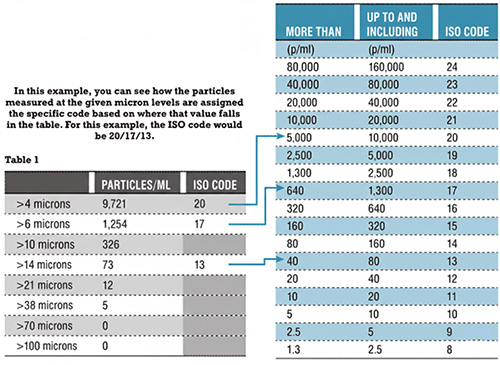 To move from guesswork to measurable results, use ISO 4406 cleanliness codes. These codes quantify particle counts at specific micron sizes and provide a standard benchmark. For instance, a code like 18/16/13 indicates contamination levels of ≥4, ≥6, and ≥14 microns.
The key to selecting and validating an effective oil filtration system is aligning it with both your current cleanliness level and your target performance standard. Your baseline cleanliness should be established through oil analysis, providing a clear picture of existing particle contamination levels. From there, you can define a target cleanliness level, typically guided by OEM specifications, warranty requirements, or internal reliability benchmarks tied to equipment performance and lifespan.
Without this alignment, it becomes difficult to measure whether your oil filtration system is delivering real value. Simply installing a system does not guarantee improved oil quality or equipment protection. By comparing pre-filtration and post-filtration oil cleanliness levels against defined targets, you can quantify performance, justify the investment, and ensure that your filtration strategy is actively contributing to improved system health and reduced wear over time.
Evaluate Total Cost of Ownership (Not Just Purchase Price)
Upfront cost rarely tells the full story when selecting an oil filtration system. A proper evaluation should consider the total cost of ownership (TCO), including installation and integration, ongoing energy consumption, maintenance frequency and labor requirements, and, where applicable, filter element replacement. These operational factors can significantly influence the system’s real cost over time and should be considered alongside the initial purchase price.
It is also important to account for performance-driven savings, such as extended oil life, fewer oil change-outs, and reduced equipment wear. An effective oil filtration system can help maintain cleaner oil for longer periods, directly contributing to improved equipment reliability and reduced maintenance demands. Over a multi-year horizon, higher-efficiency oil filtration systems often justify their initial cost by minimizing unplanned downtime and protecting critical assets. When evaluated holistically, the long-term savings and operational stability typically outweigh the upfront investment, making total lifecycle cost a far more accurate measure of value.
Prioritize System Fit and Long-Term Reliability
The best oil filtration system is one that fits your operation in every sense, physically, technically, and operationally. This means accounting for available footprint and installation constraints, ensuring the oil filtration system can be integrated without disrupting existing layouts or workflows. It also involves evaluating how easily the system can be maintained, including service access and routine upkeep, and confirming compatibility with your current equipment and processes.
Additionally, select a system that can scale with your operation as demands evolve. A properly matched solution will not only meet your current requirements but also adapt to future growth without requiring a complete overhaul. When these factors are aligned, the result is an oil filtration system that operates consistently with minimal intervention. It will maintain stable oil cleanliness levels, reduce the need for constant adjustments, and support long-term reliability across your equipment.
Choosing the right oil filtration system is about matching the application, contamination type, and performance targets, not just selecting a filter from a catalog page. When properly specified, the oil filtration system becomes a core part of your reliability strategy, protecting equipment, stabilizing performance, and lowering lifecycle costs.
Reduce maintenance costs, improve equipment reliability, and keep your equipment moving!
 Separator Spares & Equipment offers cost-effective oil filtration systems that enable businesses to improve performance and reduce costs. Oil cleanliness and contamination control are crucial to any proactive maintenance strategy. Our expertise ensures you receive the optimal solution for your specific application. We offer a comprehensive range of oil purification systems and products, designed to remove particles, water, varnish, and other contaminants from industrial fluids. Selecting the right system ensures cleaner oil, improved equipment reliability, and optimized maintenance schedules.
When selecting an oil filtration system, it is crucial to consider your oil usage and the type of fluid you are working with, such as diesel fuel, hydraulic oil, turbine oil, or lubricating oil. An oil filtration system that efficiently handles new oil and extends the life of existing oil can significantly reduce costs. Look for features such as filter carts for easy mobility and a compact design that fits into your workspace without sacrificing performance. Our oil filtration systems lower maintenance expenses, extend equipment life, and reduce total cost of ownership, all while improving reliability and energy efficiency.
In addition to complete systems, Separator Spares & Equipment also specializes in genuine and compatible filter spare parts, including filter elements, filter housings, and accessories. Whether you need replacements or upgrades, we offer trusted solutions that minimize downtime and keep your equipment running smoothly.
Oil Filtration & Purification Solutions | Products, Service, and Expertise