

Wärtsilä Oil Filtration
 Every Wärtsilä engine depends on clean lubricating oil to protect bearings, crankshafts, camshafts, piston cooling nozzles, turbochargers, and hydraulic valve components. An effective oil filtration system combines full-flow filtration with bypass centrifugal filtration to remove contaminants over a wide particle-size range.
Your Wärtsilä engine’s oil is doing a lot of work, lubricating hot moving parts and carrying away wear debris. While the primary full-flow oil filters capture larger debris, microscopic contaminants still bypass them, accelerating engine wear. That’s where a Wärtsilä centrifugal filter makes the difference. Rather than trying to trap particulate contaminants in filter media, the bypass centrifuge filter spins the oil at extremely high speed, forcing heavy solid particles such as soot, sludge, wear metals, and dirt out of the oil before they can recirculate through the engine. Reduce oil costs without compromising engine reliability with an IOW Group centrifugal filter for Wärtsilä engines.
Extend oil life and reduce lubrication costs without compromising engine reliability!
How Wärtsilä Bypass Centrifuge Filtration Actually Removes Micron-Level Contaminants
 Wärtsilä engines (whether diesel or dual-fuel) have a main oil pump and a full-flow (pressurized) oil filter. The full-flow oil filters typically trap particles only down to around 30-40 microns (30-40 µm). Any finer soot, dirt, grit, sludge, wear metals, or other solid contaminants continue to circulate. This particulate contamination causes most of the wear on bearings and camshafts. To capture the microscopic contaminants that remain after full-flow oil filtration, Wärtsilä incorporates a bypass centrifugal lube oil filter that continuously removes soot, wear particles, and sludge from the lubricating oil.
A portion of the lube oil is diverted (bypassed) through a spinning centrifuge rotor (centrifuge bowl). As the centrifuge rotor spins at high speed, it generates thousands of times the force of gravity. Dense contaminants, including soot, wear metals, sludge, dirt, and other insoluble particles, are forced against the rotor wall (centrifuge wall), where they accumulate as a compact sludge cake. The cleaned lubricating oil then drains back into the engine sump and continues circulating through the lubrication system.
Spin out microscopic engine damage with a lube oil bypass filter centrifuge!
Why Bypass Filtration is the Critical Second Stage of Engine Oil Cleaning
 Bypass filtration serves as the second stage of the engine’s oil cleaning system. While the full-flow oil filter removes larger debris, the Wärtsilä centrifugal filter continuously separates soot, wear metals, sludge, and other abrasive contaminants from the lubricating oil that the full-flow oil filter does not remove. Reducing the concentration of these fine particles helps minimize engine wear, extend lubricant life, and improve overall engine reliability. For marine and power generation operators, that translates into fewer maintenance interruptions, lower operating costs, and greater confidence that the Wärtsilä engine will be ready when it matters most.
In Wärtsilä’s 4-stroke engine lubrication schematics, you will find one or more Wärtsilä centrifuge filter units built into the crankcase cover. The centrifugal filters sit idle until oil pressure hits a setpoint. Then a spring-loaded valve directs oil through a shaft into the centrifuge rotor. As oil sprays out of centrifuge nozzles, the rotor (centrifuge bowl) spins, and all particles of dirt that are heavier than the oil are flung outwards by centrifugal force and cling to the rotor wall (centrifuge wall). The cleaned oil then exits through the centrifuge housing and returns to the oil sump.
The self-contained Wärtsilä centrifugal filter design requires no external power, using only the engine’s own oil pressure to generate the high centrifuge force (g-force) needed for continuous oil cleaning.
ISO Cleanliness Standards and the Real Impact on Wärtsilä Engine Life
 Wärtsilä’s oil cleanliness recommendations reinforce the importance of effective contamination control. For many applications, Wärtsilä specifies a maximum ISO 4406 cleanliness level of 19/17/14 (approximately NAS 8) for lubricating oil after filtration. Maintaining these cleanliness levels helps reduce abrasive wear, protect bearings and other critical components, and support long engine service life. Case studies have proven that a diesel engine with a bypass centrifuge system and a full-flow oil filter can safely double the oil drain interval compared to the stock setup. Extending oil drain periods from 700 to 1500 hours, as some operators report, becomes possible with centrifuge filtration.
Cleaner oil means bearings and camshafts see less abrasive wear, seals last longer, and oil analysis stays within limits longer. A bypass centrifugal filter continuously removes fine soot, wear metals, sludge, and other insoluble contaminants that conventional full-flow filters do not remove. Lowering the concentration of these abrasive particles helps maintain cleaner oil between maintenance intervals and supports more consistent lube oil analysis results over time.
Wärtsilä centrifugal filters are not a “set it and forget it” forever; they need routine attention. The centrifuge filter bowl accumulates sludge cake (solid waste), which must be cleaned out. A typical cleaning involves isolating the oil flow, draining the oil from the centrifuge bowl (rotor), opening the bowl (rotor), removing the hard sludge cake, wiping it clean, and reinstalling the bowl (rotor). No complex tools are needed, just hand-clearing and reassembling the centrifuge bowl. A Wärtsilä centrifugal filter requires minimal maintenance and is cleanable and reusable with no filter media or filter elements to replace; just a paper insert (Wärtsilä P/N: 473415).
Better Wärtsilä engine reliability starts with better oil filtration!
Why Upgrading Centrifuge Technology Improves Wärtsilä Engine Reliability
 A bypass centrifuge filter is critical to optimizing Wärtsilä engine lubrication. By consistently maintaining oil cleanliness to ISO 4406 (19/17/14) standards, it reduces component wear, extends service intervals, and directly lowers operational downtime and costs. Do not rely on legacy oil spinner technology to protect your Wärtsilä engine. Upgrade to an IOW Group centrifuge, the only system on the market combining patented bowl-disc technology with a fully sealed design to deliver 150% greater separation efficiency for your Wärtsilä engine.
Every hour a Wärtsilä engine operates, microscopic contaminants circulate through the lubrication system. The question isn’t whether those particles exist; it’s how effectively they are removed. By combining primary full-flow filtration with high-efficiency bypass centrifugal filtration, operators can maintain cleaner oil, reduce abrasive wear, extend lubricant service life, and improve long-term engine reliability. Whether your vessel operates offshore, in commercial shipping, power generation, or industrial service, investing in better oil filtration is one of the simplest ways to reduce lifecycle operating costs while protecting one of your most valuable assets … your Wärtsilä engine.
| Bowl Disc Technology | Remote Monitoring | Fully Sealed Centrifuge Bowl (Rotor) |
 | 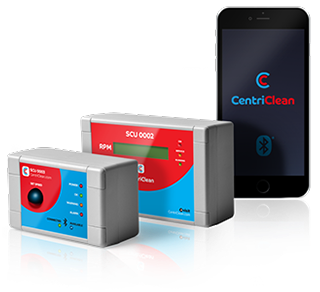 |  |
| All IOW centrifuges have bowl discs which greatly improve the separation efficiency. IOW MP centrifuges are unique in having bowl discs for these types of centrifuges - this feature is not available from any other manufacturer. | Unlike any other products on the market, IOW centrifugal filters have a choice of CentriClean remote monitoring via Separator Control Units (SCUs) which can warn you or your system that they need servicing or cleaning. | IOW centrifuges have been designed to eliminate cross contamination between contaminated oil and cleaned oil, from the unique impeller drawing oil in at the base of the units to oil-sealed components. All ensure cleaned oil and dirty oil remain separate. |
Next Generation Oil Separation: Upgrade your legacy Wärtsilä Centrifuge Filter with the IOW Group Centrifuge!
Wärtsilä Centrifugal Filter Case Studies
Across multiple global maritime and power-generation applications, IOW Group centrifugal filters have replaced factory-installed legacy separators (such as those from Mann+Hummel and Glacier). By utilizing modern internal bowl disc technology and higher operational G-forces, IOW Group centrifuge filter upgrades deliver superior oil cleanliness, real-time RPM monitoring, and measurable increases in sludge capture rates.
Wärtsilä 20 Series: Wärtsilä W6L20 Engine
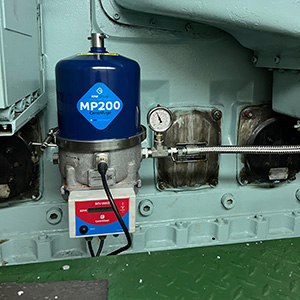
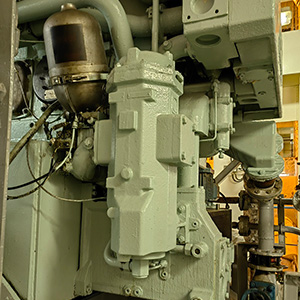 Looking to improve their Wärtsilä W6L20 engine oil filtration system, COSCO Shipping Lines turned to IOW Group. The M/V XIN XIA YAND is a crude oil tanker built in 2011, with a deadweight capacity of 309,140 MT and a length overall of 333 meters. The Wärtsilä 1025W6L20 engine uses Total AURELIA TI 4030 engine oil and operates on VLSFO (Very Low Sulfur Fuel Oil). The Wärtsilä W6L20 engine was supplied from the factory with a Mann Hummel FM200DS centrifuge.
The Mann Hummel FM200DS is a dual-source centrifuge. The FM200DS centrifuges take the low-pressure backflushing oil (backflushing oil cleaning centrifuge) from the Boll & Kirch automatic filter, but also have a high-pressure oil inlet that drives the bowl via a Pelton wheel. A centrifuge filter separation efficiency is determined by the centrifuge RPMs (g-force). Due to low oil pressure in the Boll & Kirch automatic filter, the oil pressure reaching the Pelton wheel drive is required to generate the centrifuge speed. The IOW MP200 centrifuge is not a dual-source centrifuge. For this engine installation, the IOW MP200 centrifuge was mounted on the engine crankcase cover, and the centrifuged oil gravity-drained back into the crankcase.
Results: The IOW MP200 centrifugal filter is clearly superior to the original Mann Hummel FM200DS centrifugal separator. The IOW MP200 centrifuge improved the Wärtsilä oil filtration cleanliness levels, ensuring that the lubrication oil provides good wear protection and excellent oil film strength at extreme pressures.
Conclusion: According to the customer’s evaluation, the IOW Group MP200 centrifuge offers several clear advantages over the legacy Mann Hummel FM200DS centrifugal separator, particularly in the following areas:
-
- The IOW Group MP200 centrifuge operates exceptionally smoothly. Even at centrifuge speeds of up to 5,600 RPM, vibration is barely perceptible by hand, demonstrating significantly better balance and stability than the original No. 3 auxiliary engine centrifugal separator.
- The structure of the IOW MP200 centrifugal separator is more reasonable. The IOW MP200 centrifugal separator structure is similar to that of an oil purifier (centrifugal type) and includes a set of bowl discs, which makes the structure more robust. The IOW MP200 centrifugal separator is mounted vertically on the base, providing greater stability and reliability. Compared with the original centrifugal separator with a large-inclination installation, it is more solid and reasonable, and less likely to cause vibration.
- Moreover, there is a centrifuge speed display.
- The separation effect of the IOW MP200 centrifugal separator is obviously better. The IOW MP200 centrifugal separator has been used for about 180 hours, producing 340 grams of sludge at a rate of about 1.8 grams/hour. The original centrifugal separator (#3 auxiliary machine), after cleaning, has been used for about 280 hours and produces 280 grams of sludge at a rate of about 1 gram/hour.
- The oil sludge separated by the IOW MP200 centrifugal separator is evenly distributed around the bowl body. The separated oil sludge has high density and high hardness. The oil sludge separated by the original Mann Hummel FM200DS centrifugal separator is unevenly distributed around the tank.
Superior Oil Filtration for Longer Engine Life and Reduced Wear!
Wärtsilä 20 Series: Wärtsilä W6L20 Engine
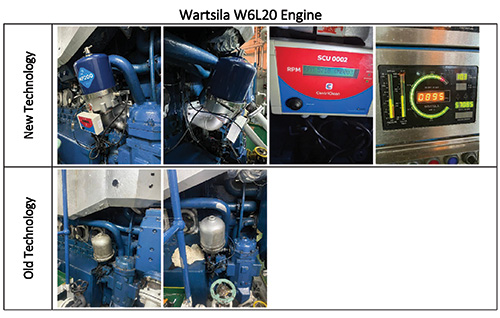 To improve the lubricating oil filtration performance of the Wärtsilä W6L20 engines aboard the M/V XIN XIA YANG, COSCO Shipping Energy Transportation selected IOW Group to upgrade its Wärtsilä oil filtration system. The M/V XIN XIA YANG is a crude oil and refined petroleum products tanker designed for reliable long-distance transportation.
The lubricating oil module built on the engine consists of the lubricating oil cooler, thermostatic valve, and automatic oil filter. The centrifugal filter is installed to clean the backflushing oil from the automatic filter. The Mann Hummel 200DS (Dual Source) centrifuge filter takes low-pressure backflushing oil from the B&K automatic filter and also has a high-pressure oil inlet that drives the bowl via a Pelton wheel. The Mann Hummel 200DS (Dual Source) centrifuge has two (2) different oil inlets:
-
- Backflushed oil from the filter (entering the cleanable rotor)
- High-pressure oil inlet that drives the Pelton wheel underneath the centrifuge bowl (this oil is not processed/cleaned by the M+H 200DS centrifuge; it is only utilized to help generate the centrifugal force)
The centrifuge flow rate is critical to the proper operation of the B&K filter, and all are interconnected. The centrifuge connections and interfaces are totally different. This installation required a centrifuge filter mounting modification, as it is not a pop-off/pop-in installation or configuration. The Mann Hummel FM200DS was replaced with the IOW MP200 centrifuge, equipped with the CentriClean SCU-0002 remote monitor.
Results: By upgrading to high-efficiency centrifugal filtration, the COSCO oil tanker vessel improved oil cleanliness, reduced engine wear, and extended lubricant service life.
Superior oil filtration with the IOW Group centrifugal filters for Wärtsilä engines!
Stork F240 Series: Wärtsilä Stork 8FHD240 Engine
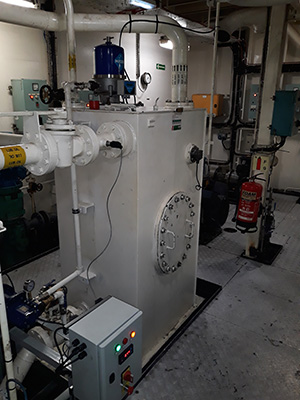 The Wärtsilä Stork 8FHD240 engine (often referred to as SWD 8FHD240 or as part of the Stork F240 series) is a heavy-duty, medium-speed, 4-stroke marine diesel engine. Widely used for mechanical propulsion and marine generator sets, this 8-cylinder in-line engine typically delivers 1,000-1,175 kW at 750 rpm. This ferry operator sought to improve the cleanliness of the dry-sump lubricating oil on the propulsion engines aboard the M/V Red Falcon, a passenger ferry operating across the Solent between mainland England and the Isle of Wight, UK.
Because the Stork Wärtsilä engine uses a dry-sump lubrication system, IOW Group engineered a dedicated installation that included an IOW Magaline 025N1 feed pump to supply oil to the IOW MP200 centrifuge. The centrifuge was mounted on the forward engine’s main sump tank. To ensure optimal separation efficiency and protect the system, a thermostatically controlled panel was also installed. This prevented the Wärtsilä centrifugal filter and pump from operating below 60°C (140°F), at which point increased oil viscosity and flow characteristics would reduce the IOW MP200 centrifuge’s cleaning performance.
Results: Running at an oil temperature of 65°C (149°F), the IOW MP200 centrifugal filter rotated at 6,200 RPMs, and after 561 run hours, the IOW MP200 centrifuge was serviced. The dirt cake (sludge cake) was nearly 12 mm thick, and just over 800 grams of sludge was removed.
Conclusion: Even with relatively low oil temperatures, which reduce the centrifugal process’s separation efficiency, the high level of dirt removal during the burning of relatively clean MGO was very impressive. The customer is reviewing oil filtration analysis following these trials and intends to install it on sister ships and other vessel types.
IOW Group Lube Oil Bypass Filter Units for Wärtsilä 4-Stroke Engines!
Wärtsilä Nohab WN25 16V25 Engine
 Given the age of these Wärtsilä Nohab WN25 (16V25) engines, the USNS Bob Hope wanted to improve their Wärtsilä oil filtration system. The Bob Hope Class is one of four classes of US Navy large, medium-speed, roll-on/roll-off (LMSR) vehicle cargo (T-AKR) ships. The ships are owned and operated by the United States Navy’s Military Sealift Command (MSC). Wärtsilä Nohab originally supplied these marine diesel oil (MDO) engines with two (2) Glacier GF200 centrifuge filters.
To compare sludge and soot removal performance, the IOW MP200 and Glacier GF200 centrifuges were operated side by side under identical conditions to evaluate their contaminant removal efficiency.
Results: After running for 46 hours, the IOW MP200 centrifuge sludge thickness was 19 mm (3/4″), while the Glacier GF200 sludge thickness was less than 6 mm (1/4″). The IOW centrifuges come standard with CentriClean SCU remote monitors; during operation, the CentriClean SCU-0002 remote monitor displayed a centrifuge RPM of 6,048. The Glacier centrifuge RPMs could not be documented because the Glacier centrifuges lack remote monitoring capabilities.
Conclusion: After completing the side-by-side evaluation of the IOW MP200 and Glacier GF200 centrifuges, this maritime customer replaced all their existing Glacier GF200 centrifuges with IOW MP200 models.
Maximize engine performance with advanced IOW Group oil filtration technology!
Wärtsilä 31 Series: Wärtsilä W8V31D Engine
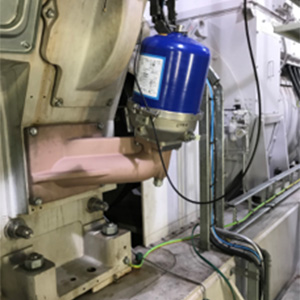 The Wärtsilä W8V31D (8V31) is a medium-speed, 4-stroke marine engine manufactured by Wärtsilä. It is an 8-cylinder V-configuration engine from the Wärtsilä 31 engine series, which holds the Guinness World Record for the most efficient 4-stroke diesel engine. This customer was looking to achieve significant savings by reducing lube oil consumption.
Looking for a better Wärtsilä centrifugal filter, this customer turned to IOW Group. At a lube oil pressure of 4.2 bar (60.9 PSI), the IOW MP600 centrifuge speed is 4,200 RPMs (displayed on CentriClean SCU remote monitor).
Results: A comment from our customer’s performance evaluation stated: “Adding an IOW Group centrifuge filter significantly reduces lubricating oil consumption by continuously removing fine contaminants that accelerate oil degradation.” By continuously removing soot and solid contaminants, the IOW Group centrifuge filter helps maintain cleaner lubricating oil, minimizing abrasive wear on critical engine components. Cleaner oil remains in service longer, reducing lube oil replacement frequency and lowering total operating costs (TOC). The result is improved engine cleanliness, greater reliability, and extended lubricant service life.
Conclusion: “Whenever we add a Wärtsilä centrifugal filter to one of our engines, we will always request and install an IOW Group centrifugal filter.”
Significant Cost Savings and Performance Benefits with an IOW Group Centrifuge Filter!
Wärtsilä 32 Series: Wärtsilä W9L32D Engine
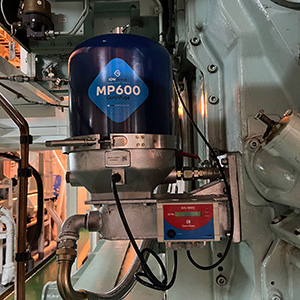
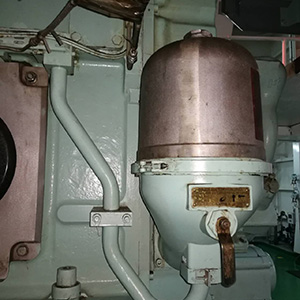 Looking to improve the oil filtration performance of their Wärtsilä W9L32D engine, COSCO Shipping turned to IOW Group for a proven centrifugal filtration solution. The M/V COSCO SHIPPING VIRGO is an ultra-large container ship built in 2018 with a length of 399.8 meters. This Wärtsilä W32 series engine operates on VLSFO (Very Low Sulfur Fuel Oil). The Wärtsilä W9L32D engine was supplied from the factory with a Mann Hummel FM600DS centrifuge.
The Mann Hummel FM600DS is a dual-source centrifuge. The FM600DS centrifuges take the low-pressure backflushing oil (backflushing oil cleaning centrifuge) from the Boll & Kirch lubricating oil automatic filter, but also have a high-pressure oil inlet that drives the bowl via a Pelton wheel. A centrifuge filter separation efficiency is determined by the centrifuge RPMs (g-force). Due to low oil pressure in the Boll & Kirch automatic oil filter, the oil pressure reaching the Pelton wheel drive is required to generate the centrifuge speed. The IOW MP600 centrifuge is not a dual-source centrifuge. For this engine installation, the IOW MP600 centrifuge was mounted on the engine, and the centrifuged oil gravity-drained back into the crankcase.
Results: The IOW MP600 centrifugal filter is clearly superior to the original Mann Hummel FM600DS centrifugal separator. The IOW MP600 centrifuge improved the Wärtsilä oil filtration cleanliness levels, ensuring that the lubrication oil provides good wear protection and excellent oil film strength at extreme pressures.
Upgrade your Wärtsilä W32 Oil Filtration – Request a quote for the proven IOW MP600 Centrifuge Filter today!
Wärtsilä 34 Series: Wärtsilä 18V34SG Engine
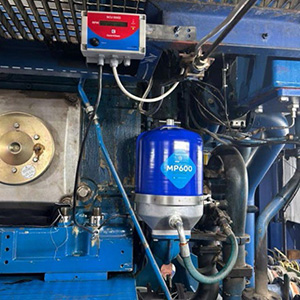
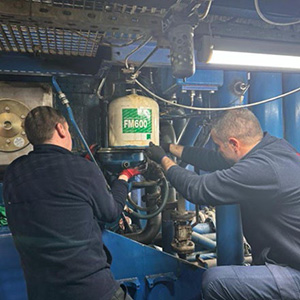 The Wärtsilä 18V34SG is a highly efficient, four-stroke, spark-ignited, lean-burn natural gas engine generating set. Designed for power optimization and rapid load response, the Wärtsilä 34SG series power-optimized gas engine is especially suitable for balancing renewable power generation. The Wärtsilä 8V34SG engine was originally equipped with a Mann Hummel FM600 centrifuge.
Seeking to improve the performance of their Wärtsilä lube oil filtration system, this power generation customer upgraded from the Mann+Hummel FM600 centrifuge to the IOW MP600 centrifuge filter, complete with the standard CentriClean SCU-0002 remote monitoring system.
Results: Based on lube oil analysis, this power generation customer saw a significant decrease in insolubles (%), cleaner oil as indicated by an improved ISO 4406 cleanliness code, lower wear metal concentrations, and a lower PQ index, indicating improved oil cleanliness and a reduction in circulating ferrous debris.
Conclusion: The IOW MP600 centrifugal oil filter delivered superior contaminant removal by capturing more ash particles, carbon, oxidation by-products, sludge, soot, and other fine insoluble solid contaminants than the previous Mann Hummel FM600 centrifuge. By maintaining cleaner lubricating oil, the system helped reduce abrasive wear and improve overall engine protection. The customer reported, “We are achieving maximum engine performance with the advanced IOW Group oil filtration technology.”
Achieve maximum engine performance with advanced oil filtration technology by IOW Group!
Wärtsilä 46 Series: Wärtsilä 12V46 Engines
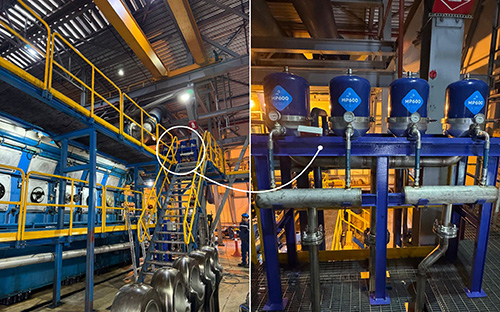 This state-owned electric utility and power generation company is running Wärtsilä 12V46 medium-speed, four-stroke diesel engines. Because this country’s power grid is heavily reliant on hydroelectricity, facilities like this are critical during dry seasons and droughts to help offset generation deficits. To ensure reliable energy output for the national electricity system, this power plant has undergone significant maintenance and upgrades to its Wärtsilä oil filtration system.
These Wärtsilä 12V46 engines operate on Fuel Oil #6 (Bunker C or Heavy Fuel Oil (HFO)) and use SAE 40 BN40 lubricating oil, with a total lube oil system volume of 3,800 gallons (14,385 liters). Due to the sump size, two (2) kidney loop systems were installed. Each kidney loop system consisted of two (2) IOW MP600 oil-cleaning centrifuges equipped with CentriClean SCU-0002 remote monitoring systems, providing continuous, real-time supervision of oil filtration performance and operating conditions throughout the lubrication system.
Wärtsilä 12V46 Kidney Loop System
Wärtsilä Centrifugal Filter
By supplying cleaner oil to the engine, the centrifuge filter helps improve cylinder conditions by reducing wear from abrasive particles. Better cylinder cleanliness promotes more efficient engine performance and reduces maintenance requirements. The combined benefits of cleaner oil, reduced contamination, and lower wear help extend the service life of cylinders and other critical engine components, improving engine reliability while reducing long-term maintenance costs.
If your Wärtsilä engine is equipped with a centrifugal lube oil cleaning system (bypass centrifuge) that continuously removes insoluble contaminants and maintains oil cleanliness between service intervals, upgrading or replacing it with an IOW Group centrifugal oil filtration system can enhance fine particle removal efficiency, improve oil cleanliness stability, and provide advanced real-time monitoring of oil filtration performance.
Upgrade your Wärtsilä lube oil system with IOW centrifugal filtration to reduce wear, improve cleanliness, and extend cylinder life!

The soot removal rate of three (3) Mann Hummel FM600s = One (1) IOW MP600 Centrifugal Filter
By supplying cleaner oil to the engine, the oil centrifuge helps improve cylinder conditions by reducing abrasive wear. Better cylinder cleanliness promotes more efficient engine performance and reduces maintenance requirements. The combined benefits of cleaner oil, reduced contamination, and lower wear help extend the service life of cylinders and other critical engine components, improving engine reliability while reducing long-term maintenance costs.
Act now to optimize your Wärtsilä oil filtration system. Ready to reduce costs and improve engine reliability? Contact Separator Spares & Equipment today for a Wärtsilä centrifugal filter solution.
Wärtsilä Centrifugal Filter by IOW Group: Cleaner Oil. Longer Engine Life. Lower Operating Costs. Request Your Quote Today!