

Varnish Mitigation System
 What is varnish mitigation?
Varnish mitigation is a proactive maintenance strategy for removing soft contaminants and byproducts of oil degradation from industrial lubricants. Unlike standard particulate filtration, it utilizes sub-micron adsorption and continuous kidney-loop processing to prevent servo-valve stiction, reduce MPC (ASTM D7843) levels, and help improve varnish-handling capacity by removing insoluble contaminants and maintaining cleaner oil.
Key Symptoms of Oil Varnish
If you are experiencing any of the following, your system likely has a high varnish potential (MPC):
– Servo-valve Stiction: Erratic stick-slip behavior or unit trips.
– Elevated Bearing Temperatures: Oil varnish acts as an insulator, reducing heat transfer.
– Shortened Filter Life: Rapid increase in differential pressure (ΔP) despite “clean” oil.
– Critical MPC Levels: A ΔE value > 30, even if the Total Acid Number (TAN) remains normal.
Identifying these symptoms early is the first step toward implementing an effective varnish mitigation program that protects your capital equipment.
Why Varnish Mitigation is a Mission-Critical Strategy
Beyond simple removal, varnish mitigation is a mission-critical reliability strategy in modern turbomachinery and hydraulic systems. What was once considered a secondary contamination issue is now a primary cause of unplanned downtime, especially in systems operating with high temperatures, tight tolerances, and long oil life cycles.
Varnish has a direct and compounding impact on system reliability. Because servo-valves have extremely tight tolerances, even a microscopic layer of oil varnish can cause a unit trip or fail-to-start condition. As the oil degrades, impurities form. As deposits accumulate, they increase wear on critical components, leading to premature failure and costly pump damage.
In process environments, varnish can compromise product integrity and drive higher scrap rates. Operationally, this translates into unplanned downtime for valve and pump repairs. Over time, varnish also contributes to start-up failures and accelerates the formation of oil degradation products, further amplifying maintenance costs and reliability risks. Understanding lubricant degradation can help you address some of the underlying causes of varnish formation.
What is varnish?
Varnish is the accumulation of oil degradation byproducts that adhere to the internal surfaces of lubricating and hydraulic systems. As equipment tolerances become tighter and efficiency demands continue to rise, varnish has emerged as a widespread reliability issue across industrial operations. This trend has been further accelerated by the industry-wide shift to Group II base oils, which, while more refined and stable, have lower solvency and reduced ability to suspend degradation products in the oil. As these oils struggle to hold contaminants, the need for dedicated varnish mitigation becomes even more critical to prevent rapid deposit buildup.
From a technical standpoint, varnish is a thin, oil-insoluble deposit formed by the degradation of lubricant. It originates primarily from oxidation, thermal stress, and contamination. When lubricating oil is exposed to heat, oxygen, and pressure, it undergoes oxidation and varnish formation. However, even small amounts of water trigger hydrolysis, a chemical reaction breakdown that accelerates the formation of organic acids. These acids further destabilize the fluid, leading to a rapid increase in varnish potential and copper corrosion on yellow metal components. These byproducts differ significantly from the base oil; they are less soluble, electrically polar, and highly prone to adhering to metal surfaces within the system.
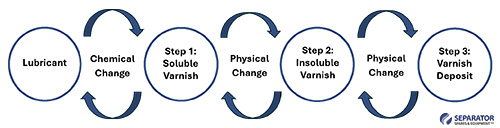 Varnish exists in two states: soluble varnish and insoluble varnish. In its soluble varnish form, varnish remains dissolved in the oil and is essentially invisible. However, once the oil becomes saturated or conditions change, these degradation products precipitate from solution, forming deposits. This leads to what is commonly referred to as the “varnish cycle.” As oil temperature increases, varnish tends to remain dissolved. When the oil cools, particularly in low-flow or stagnant areas, these compounds precipitate and deposit onto metal surfaces.
However, temperature is not the only trigger; pressure drops across valves or orifices can contribute to localized cooling and varnish deposition; the mechanism is often discussed more broadly as pressure-drop-related precipitation, not just Joule-Thomson cooling.
Why ISO 4406 Cleanliness is Not Enough
Many operators rely on ISO 4406 as the primary indicator of oil cleanliness. While this standard is highly effective for measuring particulate contamination, it is limited to counting particles at sizes of 4, 6, and 14 microns. This makes it an excellent tool for tracking hard particle contamination, but not for identifying all forms of degradation present in the oil. The limitation becomes critical when dealing with varnish. Varnish precursors are typically submicron in size, often less than 1 micron, and exist as dissolved or soft contaminants. Because these soft contaminants are translucent and deformable, they are effectively invisible to conventional particle counters and fall completely outside the detection range of ISO 4406 measurements.
The result is a significant blind spot in oil analysis. A system can report “clean oil” according to ISO standards while still carrying a high concentration of varnish-forming compounds. This creates a false sense of security, where operators believe the system is protected, even as varnish continues to form, precipitate, and deposit on critical components. Relying solely on ISO cleanliness codes often leads to deferred varnish mitigation, allowing sub-micron precursors to saturate the system unnoticed.
Measuring varnish requires more than traditional particle counting. It demands a method that can detect the presence and severity of oil degradation byproducts. The industry standard for this is ASTM D7843, commonly known as Membrane Patch Colorimetry (MPC) testing. This method is specifically designed to quantify varnish potential by identifying insoluble degradation products in the oil. These tests are critical for identifying potential problems associated with system varnish.
Monthly MPC testing is recommended for all critical turbine installations!
The MPC process involves taking an oil sample, mixing it with a solvent, and filtering it through a fine 0.45-micron nitrocellulose patch. ASTM D7843 extracts insoluble varnish-related material onto a 0.45 μm patch and reports the resulting stain as ΔE. These deposits create a visible stain, which is then analyzed using a spectrophotometer. The result is reported as a ΔE value, representing the intensity of the color change and, by extension, the varnish potential of the oil.
Common industry guidance is to treat higher ΔE values as increasing varnish risk, with exact alert limits set by the equipment owner or oil analysis provider. A ΔE value below 15 is considered normal/good (ΔE<15) and indicates minimal varnish risk. Values between 15 and 29 suggest the need for closer monitoring/warning (ΔE = 15-29), as varnish precursors begin to accumulate. A range of 30 to 39 is classified as abnormal (ΔE = 30-39) and typically requires corrective action. Any value above 40 is considered critical (ΔE > 40), indicating a high risk of varnish deposit formation and potential equipment failure.
The higher the MPC value, the higher the amount of varnish deposits and precursors dissolved in the lubricant, and the greater the propensity for the lubricant to form harmful varnish deposits. It is a common misconception that a stable Total Acid Number (TAN) indicates a system is free of varnish. While TAN is a valuable traditional metric for tracking fluid oxidation products, it often fails to trend with varnish potential. TAN may not track varnish risk closely, so MPC is often more useful for varnish trending than TAN alone.
MPC testing is essential because it measures varnish potential rather than just particulate contamination. Unlike traditional cleanliness standards, which focus on larger particles, MPC captures sub-micron degradation products that lead to varnish formation. This makes it a critical tool for proactive maintenance, enabling operators to identify and mitigate risks of varnish formation before they lead to operational issues or unplanned downtime.
ISO 4406 (Particle Count) ASTM D7843 (MPC) Target Hard Particles (Dirt, Metal) Soft Contaminants (Varnish) Detection Size > 4, 6, 14 microns Sub-micron (< 0.45 microns) Primary Goal Component Wear Protection Preventing Valve Stiction Limit Blind to Dissolved Degradation Direct Measure of Varnish Potential
Varnish Mitigation Solutions
There are two primary philosophies for managing oil health: Solvency Enhancers and Physical Removal. While chemical cleaners (solvency enhancers) can temporarily keep byproducts in suspension, they do not address the root cause and can sometimes adversely affect the oil’s demulsibility. Physical removal, such as the technology found in Kaydon Varnish Removal Systems, uses sub-micron filtration and adsorption to remove contaminants from the system entirely. This not only cleans the oil but restores its natural fluid solvency, allowing it to ‘scrub’ existing deposits off internal metal surfaces
The Kaydon Physical Removal Advantage
Varnish mitigation requires a continuous, system-level approach, and Kaydon Filtration addresses this challenge with dedicated varnish removal systems engineered specifically for turbine and industrial lubrication applications. Unlike conventional filters, which are limited to removing larger particulate contamination, Kaydon varnish mitigation systems are designed to target sub-micron varnish-forming materials and oil degradation byproducts that exist in both soluble and insoluble states. This approach focuses on continuously conditioning the oil to prevent varnish deposits from forming, rather than reacting after varnish deposits have already caused operational problems.
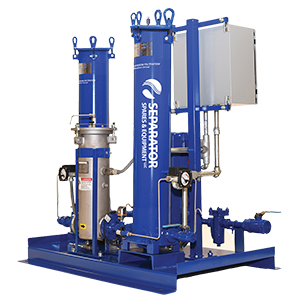
Kaydon KPV-10 Varnish Removal System
A central oil solution is the Kaydon KPV-10 Varnish Removal System, which operates as a kidney-loop system independent of the main lubrication circuit. This independent operation ensures that varnish mitigation continues around the clock, even when the main turbine is offline or in standby. This allows the unit to continuously draw oil from the reservoir, process it through multiple stages, and return clean oil to the system without interrupting operation. By maintaining a constant cycle of contaminant removal, the system reduces varnish precursors in the oil.
Kaydon’s varnish removal technology uses a multi-stage process that includes pre-filtration, sub-micron particle agglomeration, and final polishing. This combination enables the varnish removal system to address the full spectrum of varnish deposits, from ultra-fine suspended contaminants to larger soft deposits. By capturing these materials before they adhere to metal surfaces, the varnish removal system helps prevent common varnish-related issues, such as valve stiction, restricted oil flow, and reduced heat-transfer efficiency. The continuous nature of the process ensures that varnish is managed proactively rather than intermittently.
Operating at a maximum flow rate of 10 GPM (38 LPM), the Kaydon KPV-10 varnish removal system can clean out a turbine lube oil system with a pre-existing varnish problem or be installed in new installations where varnish can be blocked. The varnish removal system uses easy-to-understand, easy-to-operate controls and simple installation. The filtration of the varnish producing sub-micron particles is made possible by the Kaydon Filtration technology K1100 prefilter and K4100 polishing element. The Kaydon KPV-10 varnish removal system has a 15/13/11 ISO Cleanliness level performance.
Dislodge Varnish Buildup and Block Future Attacks
The key advantage of Kaydon Filtration varnish mitigation systems is their ability to deliver ongoing varnish control while the equipment remains in service. This eliminates the need for frequent oil changes or disruptive maintenance interventions. By maintaining cleaner oil and reducing the accumulation of fluid degradation byproducts, these systems extend lubricant life, protect critical components, and improve overall system reliability. For facilities operating high-value assets such as turbines and hydraulic oil systems, implementing a dedicated Kaydon varnish mitigation solution is a direct investment in uptime, performance, and long-term operational stability.
How to Select the Right Varnish Mitigation System
Selecting the right varnish mitigation system is critical for maintaining the reliability and longevity of industrial and hydraulic lubrication systems, and Kaydon Filtration provides solutions that simplify the process. When evaluating a Kaydon varnish removal system, the first consideration is the size of the oil reservoir. Proper system sizing ensures the unit can effectively process the total oil volume within a timeframe that maintains consistent cleanliness, preventing varnish from forming or redepositing on critical components.
Flow rate is another essential factor. Kaydon varnish mitigation systems are engineered to handle specific gallons per minute (GPM) capacities, enabling continuous circulation through the varnish-removal unit without disrupting normal operations. Matching the system’s flow rate to the equipment’s needs ensures optimal contaminant removal and maintains the oil in a clean, stable condition.
The type of oil in use is also important. Kaydon varnish removal systems are compatible with various base oils, including Group II and Group III formulations, which differ in solvency and thermal stability. Selecting the system with consideration for oil type ensures that varnish precursors are effectively captured and that the system operates efficiently under normal thermal conditions.
Operating temperature and contamination severity are additional critical factors. Kaydon systems are designed to function effectively at the typical operating temperatures of turbines, compressors, and hydraulic equipment. Integration with Membrane Patch Colorimetry (MPC) monitoring allows the system to be matched to the severity of varnish risk, ensuring that high-MPC oils receive the proper level of filtration and adsorption for proactive mitigation.
By evaluating these parameters, reservoir size, flow rate, oil type, operating temperature, and MPC-based contamination severity, facilities can select the best Kaydon varnish mitigation system to provide continuous, effective protection against varnish formation, extending oil life, and safeguarding critical equipment.
 Separator Spares & Equipment, LLC is an Authorized Kaydon Filtration Distributor. We are committed to providing cost-effective oil filtration systems for critical systems that will positively impact your business. Kaydon Filtration is a global leader in advanced hydraulic oil, lubrication oil, and fuel conditioning solutions. We can assist with turbine oil purification products, solutions, and expertise. We offer a broad range of oil filtration products for industrial fluids designed to remove particles, water, eliminate varnish, and other contaminants. Our cost-effective hydraulic oil filtration system and turbine oil purification systems will lower maintenance costs (reducing total cost of ownership), increase reliability, and reduce energy consumption.
Power generation equipment and hydraulic systems have experienced an increase in varnish-related issues due to higher operating temperatures, smaller reservoirs, and electrostatic discharge. Approximately one in three large industrial gas turbines shows signs of oil varnishing. Addressing these modern challenges requires a specialized varnish mitigation approach that goes beyond standard filtration to chemically and physically restore oil health. Separator Spares & Equipment offers several solutions to help identify, prevent, and eliminate varnish from your lubrication system before it’s too late. Contact us today to remove harmful varnish from your lubrication system.
Separator Spares & Equipment provides kidney-loop oil-processing technology to remove harmful system varnish from turbine oil lubrication systems. The successful removal of varnish from turbine oil is essential for the operation of efficient, cost-effective systems. The process has been uniquely developed to remove lubricating oil varnish and system varnish without interrupting customer production. To learn more about power plant oil filtration, visit Power Plant Oil Filtration: Optimizing Turbine Reliability with Kaydon Filtration.
Varnish Mitigation Systems