

Fuel Filtration – The Importance of Clean Diesel
 In the high-stakes environments of industrial machinery, power generation, maritime operations, and transportation, diesel fuel is the primary energy source powering critical engines. Yet diesel fuel is more than just a consumable; it is a precision operating fluid that directly impacts engine reliability, efficiency, and long-term performance. Contaminants such as water, sediment, microbial growth, and degraded fuel can quickly compromise injection systems, reduce combustion efficiency, and accelerate component wear. For operators who depend on continuous uptime, maintaining clean, stable diesel fuel is not optional. Fuel Filtration is a fundamental requirement for protecting engines, extending service intervals, and ensuring dependable operation in demanding environments.
Maintaining diesel fuel quality begins with effective contamination control. Modern diesel engines rely on high-pressure fuel injection systems with extremely tight tolerances, making them particularly vulnerable to particulate contamination and water intrusion. Even small amounts of debris or free water can damage injectors, reduce combustion efficiency, and lead to costly downtime. To protect these critical systems, operators increasingly rely on advanced fuel conditioning technologies, including high-efficiency depth filtration, water separation, and continuous diesel fuel polishing. Diesel fuel water filtration solutions from manufacturers such as Kaydon Filtration and Facet Filtration are widely used across industrial, power generation, and maritime sectors to remove harmful contaminants before diesel fuel reaches sensitive engine components, helping ensure reliable operation and longer equipment life.
Contamination is inevitable, but effective fuel filtration is not optional!
One of the most effective strategies for protecting diesel engines is implementing a multi-layered fuel conditioning approach. Diesel fuel contamination can originate from several sources, including storage tank corrosion, condensation, microbial activity, transportation handling, and environmental exposure during fueling operations. Once introduced into the fuel supply, contaminants can circulate through fuel tanks and distribution systems, eventually reaching sensitive engine components.
To mitigate these risks, many operators combine high-efficiency diesel fuel filtration systems, such as those from Kaydon Filtration and Facet Filtration, with an industrial diesel fuel water separator or advanced centrifugal separation technologies from manufacturers such as GEA Westfalia Separator. When properly integrated, these fuel filtration technologies remove water, sediment, and other contaminants before the diesel fuel enters the engine, creating a cleaner, more stable diesel fuel supply that supports improved reliability and longer service intervals.
The Evolution of Modern Diesel Engines and the Need for Purity
The shift from mechanical fuel injection to electronic high-pressure common rail (HPCR) systems has transformed engine performance, delivering improved fuel economy and lower emissions. However, these benefits come with increased sensitivity. In modern HPCR systems, fuel is pressurized to tens of thousands of PSI, commonly between 20,000 and 35,000 PSI, depending on the engine, and delivered through precision injectors with tightly controlled internal clearances. To put this in perspective, a 15 µm particle, barely visible under a microscope, can be large relative to the tiny passages within a common rail injector. If such solid particles bypass filtration, they can act like high-pressure abrasives, causing accelerated wear or damage to precision components.
Don’t let contaminated diesel fuel ruin your engines!
On-engine fuel filters often lack sufficient capacity for primary protection, leading to more frequent replacements and potential particulate bypass. This is why primary fuel filtration at the point of dispensing or in bulk storage is critical for protecting sensitive HPCR components and preventing on-engine fuel filters from plugging prematurely.
Understanding the Contamination Cycle: Why Fuel Gets Dirty
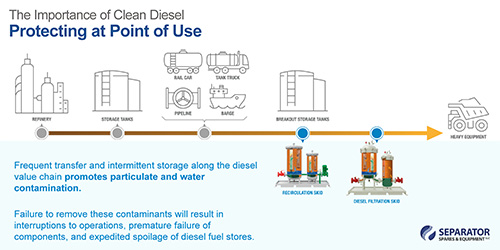 Diesel fuel contamination is an ongoing challenge throughout the diesel supply chain. From refinery distribution to the final point of use, fuel is repeatedly transferred, stored, and handled. Each step introduces opportunities for particulate matter and water to enter the system, gradually degrading diesel fuel quality before it ever reaches the engine.
How Contaminants Enter the System
Transfer Operations: Every transfer, whether between barges, railcars, tanker trucks, or storage fuel tanks, creates a risk of fuel contamination. Dust, rust, pipe scale, and other airborne debris can enter through open connections, vents, or handling equipment.
Storage Tank Condensation: Temperature fluctuations cause storage fuel tanks to “breathe,” drawing humid air into the diesel tank as internal pressure changes. When the air cools, moisture condenses on the walls of the diesel tank and eventually settles to the bottom of the tank as free water, creating an environment that can accelerate corrosion and microbial growth.
Supply Chain Exposure: Diesel fuel often passes through multiple storage and transportation stages before reaching end users. Contamination can occur at any point along this chain, which is why monitoring and treating fuel as it enters and leaves storage is essential.
Contamination is an ongoing challenge; maintaining fuel integrity requires a proactive, multi-stage strategy.
When contaminants are not removed, the consequences appear quickly: plugged fuel filters, accelerated wear of fuel system components, unplanned downtime, and costly emergency maintenance. Effective fuel management and fuel oil filtration strategies are, therefore, critical to maintaining reliability and protecting modern diesel equipment. By implementing bulk fuel filtration at both the inlet (receiving) and outlet (dispensing) of your storage fuel tanks, you break the contamination cycle and ensure that the fuel reaching your engines meets or exceeds ISO 4406 cleanliness standards.
The Dual Threat: Solid Particulates and Water Contamination
Diesel fuel contamination generally falls into two primary categories: solid particulates and water contamination. Both can significantly degrade diesel fuel quality and cause cascading reliability issues in diesel fuel systems.
Solid Particulate Damage
Solid contaminants such as dust, dirt, rust, pipe scale, and wear debris can cause multiple damaging failure mechanisms within diesel engines. Beyond simple abrasive wear, particulate contamination can promote carbon buildup and coking on injector tips and nozzles, interfering with proper injector operation and degrading fuel atomization. Contaminants can also erode or foul precision injector components, distorting the intended spray pattern and leading to incomplete combustion, reduced engine efficiency, power loss, and increased exhaust emissions. As combustion quality deteriorates, higher levels of soot and unburned hydrocarbons place additional strain on downstream emissions systems such as Selective Catalytic Reduction (SCR) units and Diesel Particulate Filters (DPF), ultimately reducing aftertreatment efficiency and increasing maintenance requirements.
Water Contamination Damage
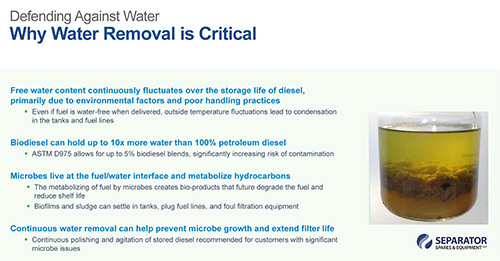
Water is often the most problematic contaminant in diesel fuel systems because it can exist in several forms: free water, emulsified water, or dissolved water, and even small quantities can create significant operational problems. The risk has increased with the widespread use of biodiesel blends, as biodiesel components are more hygroscopic than petroleum diesel and therefore absorb and retain more moisture. As a result, biodiesel-blended fuels can hold more dissolved water, increasing the likelihood of water contamination during storage and handling.
Water in diesel fuel promotes corrosion in fuel tanks, piping, and precision fuel system components, and creates an ideal environment for microbial growth at the fuel–water interface. These microbes metabolize hydrocarbons and produce biomass, acids, sludge, and biofilms that foul fuel tanks, plug fuel lines, and rapidly clog fuel filters. In addition, water accelerates oxidation and fuel instability, reducing the storage life and overall quality of diesel fuel. For these reasons, effective water separation and particulate fuel filtration are essential elements of a comprehensive diesel fuel management strategy.
Stop Equipment Downtime: Request a Quote for Advanced Removal of Water in Diesel Fuel
Technical Deep Dive: Measuring Fuel Filtration Performance
ISO 4406 Cleanliness Codes
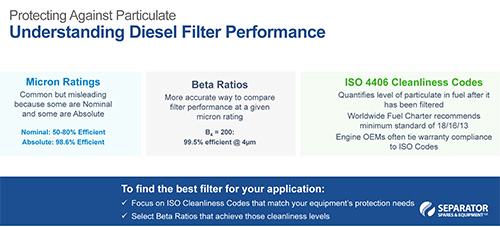 Fuel filtration performance is typically measured using standardized cleanliness metrics that quantify the number and size of particles present in fuel. The most widely used method is the ISO 4406 cleanliness code, which expresses particulate contamination as a three-number code (for example, 18/16/13). Each number represents the particle count per milliliter of fuel at specific particle sizes: 4 µm, 6 µm, and 14 µm. Lower numbers indicate cleaner fuel. The Worldwide Fuel Charter recommends a baseline cleanliness level of 18/16/13 for diesel fuel, and many engine manufacturers now reference similar standards when defining fuel quality requirements. In some cases, maintaining fuel cleanliness within these limits is directly tied to equipment reliability and warranty compliance.
High-efficiency fuel filtration systems can significantly improve these cleanliness levels. Advanced fuel filtration media used in modern fuel conditioning systems can reduce contamination well beyond the recommended baseline, in some cases achieving cleanliness codes as low as 10/9/6, which represents a dramatic reduction in the number of damaging particles circulating through sensitive fuel system components such as high-pressure pumps and injectors.
Beta Ratios vs. Micron Ratings
Another critical metric for evaluating fuel filtration performance is the Filter Beta Ratio, which provides a more precise measure of filter particulate removal efficiency than traditional micron ratings. A filter labeled as “10-micron” may only indicate the approximate particle size it targets and may capture only about half of those particles if it is rated as nominal. The Beta Ratios, however, measure the ratio of particles counted upstream of the filter element to those counted downstream of the filter element during standardized testing.
For example, a rating of β₄ ≥ 200 means that for every 200 particles measuring 4 µm entering the filter, only one passes through, equivalent to 99.5% capture efficiency at that particle size. This metric provides a far more accurate basis for comparing fuel filtration performance and ensuring that fuel systems receive the level of protection required by diesel engines.
The Mechanics of Effective Fuel Filtration
Effective fuel filtration relies on a carefully engineered, multi-stage approach that addresses both particulate removal and water separation. Modern fuel systems, particularly in marine, industrial, and power generation applications, demand extremely clean fuel to prevent wear, maintain efficiency, and protect high-pressure injectors. Achieving the desired ISO cleanliness levels, sometimes as low as 10/9/6, requires more than a single fuel filter; it requires a sequence of fuel filtration and fuel conditioning steps.
Step 1: Particulate Pre-Filtration
Pre-filtration serves as the first line of defense against contamination. Dust, dirt, and other solid particulates can quickly overload downstream coalescing media, reducing overall system efficiency. Facet Filtration and Kaydon Filtration provide diesel fuel filters with Microglass and Cellulose media in lengths from 14″ to 56″. These fuel filters can capture particles as small as 1 micron up to 25 microns, removing over 99.5% of particles at the rated size to ensure exceptionally clean fuel. This stage ensures that most harmful particles are removed early, extending the life of subsequent fuel filtration stages and protecting sensitive fuel system components.
Step 2: The Coalescing Process (Water Removal)
 Water in diesel fuel can compromise engine performance and reliability. Coalescing filters from Facet Filtration and Kaydon Filtration are designed to reduce water content (water contamination) using a multi-stage process:
Initial Capture: Fuel flows through a coalescing element made of microglass or specialized fiber media, which attracts and traps microscopic water droplets.
Droplet Growth: As trapped water droplets accumulate, they merge on the media surface, forming larger drops.
Separation by Gravity: The larger water droplets settle into a collection sump or drain chamber, preventing them from continuing downstream.
Final Fuel Filtration: In some designs, a hydrophobic layer or secondary coalescing stage further minimizes residual water, ensuring the fuel reaching the engine is largely water-free.
Eliminate 99.5% of particulates at the rated size before they ever touch your on-engine filters.
This process provides reliable water separation while maintaining optimal fuel flow, consistent with the specifications of both Facet and Kaydon coalescing filters. By combining advanced particulate pre-filtration with a sophisticated coalescing process, high-efficiency fuel filtration systems from Facet and Kaydon can achieve exceptional cleanliness levels, protecting engines and generators in demanding environments. These fuel filtration systems not only reduce wear and maintenance costs but also improve operational reliability and extend component life. Properly implemented, multi-stage fuel filtration ensures fuel integrity, safeguarding the performance of modern high-pressure, high-efficiency engines.
Versatile Solutions: Comprehensive Diesel Protection from Refinery to Point of Use
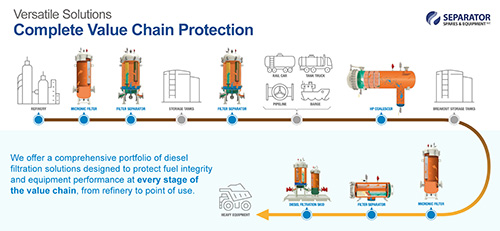 At every stage of the fuel value chain, from refinery production to final engine combustion, fuel filtration hardware must be precisely matched to flow rates and environmental stressors. Facet Filtration and Kaydon Filtration provide engineered fuel systems for high-capacity bulk handling and compact point-of-use protection, ensuring that diesel fuel meets the cleanliness requirements of high-pressure common rail (HPCR) systems.
Ensure every gallon of diesel meets the rigorous purity standards your high-performance engines demand. Diesel engines can be ruined by as little as one spoonful of dirt, as 15µm particles are three times larger than the clearances in HPCR injectors. By implementing these tiered filtration strategies, operators can ensure compliance with ISO 4406 standards (typically 18/16/13 or better), reducing unplanned downtime and protecting expensive engine components.
Upstream and Bulk Storage Vessels
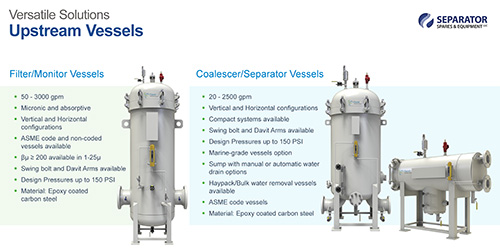 For high-volume transfer and terminal operations (50 to 3,000 gpm), bulk diesel fuel filtration vessels are the primary defense against large-scale contamination.
Filter/Monitor Vessels: These vessels support micronic and absorptive filtration, with efficiencies of βμ ≥ 200 (99.5% removal) for particles 1–25µm. Construction includes epoxy-coated carbon steel or ASME-coded designs with design pressures up to 150 PSI.
Coalescer/Separator Vessels: Engineered for high-efficiency bulk water removal (20 to 2,500 gpm), these systems utilize a multi-stage process where microscopic water droplets are trapped, merged into larger drops, and settled out by gravity
Facet Filtration and Kaydon Filtration fuel systems in these categories provide robust, high-capacity solutions for refineries, storage terminals, and large fuel transfer operations. These systems are essential for refineries and diesel tank farms to mitigate the risks of fuel spoilage and microbial growth (diesel bug) at the fuel/water interface. Facet Filtration and Kaydon Filtration ASME-coded bulk vessels provide 99.5% particulate removal efficiency, stabilizing your supply chain before fuel ever leaves the storage tank farm.
Point-of-Use Protection
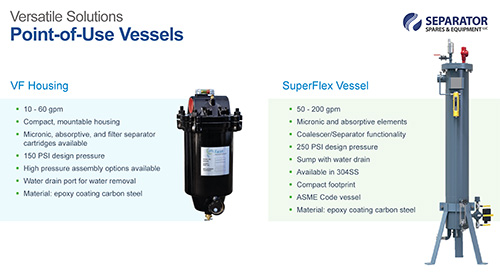 Compact fuel filtration is critical at dispensing points, mobile rigs, and auxiliary units where space is limited but protection is non-negotiable.
SuperFlex Vessels: Rated for 50–200 gpm, these 304 stainless steel or epoxy-coated carbon steel vessels provide full coalescer/separator functionality in a compact footprint. They are ASME Code-certified and designed for pressures up to 250 PSI.
VF Housings: Ideal for tight-clearance dispensing lines (10–60 gpm), these mountable housings support micronic, absorptive, or filter/separator cartridges. They feature a dedicated sump and water drain port to ensure dry fuel enters the diesel equipment.
Implement a final line of defense with mountable housings that remove residual moisture and debris at the critical moment of delivery. These solutions ensure that fuel remains clean and water-free immediately before delivery to the engine, reducing wear and operational risk.
Specialized Fuel Filtration Systems
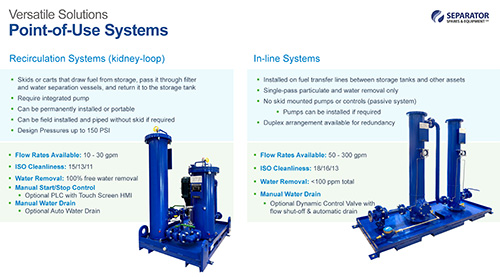 Beyond single-pass filtration, specialized configurations maintain diesel fuel integrity during long-term storage or high-frequency transfer. For targeted or continuous diesel fuel conditioning, Facet Filtration and Kaydon Filtration offer specialized fuel systems:
In-line Systems: Installed directly on transfer lines, these passive, single-pass fuel systems provide immediate particulate and water removal. Duplex arrangements are available to allow for continuous operation during element changeouts. Capable of achieving ISO Cleanliness Codes as low as 18/16/13 and reducing water content to <100 ppm total.
Recirculation (Kidney-Loop) Systems: By continuously drawing fuel from storage, passing it through high-efficiency filtration, and returning it, these fuel systems “polish” stored diesel. Regular use prevents microbial growth, water accumulation, and particulate buildup, extending fuel life and protecting engines. Capable of achieving ISO Cleanliness Codes as low as 15/13/11 and reducing water content to <100 ppm.
Go beyond single-pass fuel filtration with kidney loop systems that continuously ‘polish’ stored diesel to achieve elite ISO 15/13/11 purity levels. Regular recirculation prevents the buildup of biofilms, sludge, and tank-bottom sediment, significantly extending the shelf life of stored fuel. These flexible configurations allow owners and operators to match fuel filtration strategy to fuel type, storage conditions, and end-use requirements, maintaining optimal diesel fuel quality across the supply chain.
Proven ROI: Real-World Industrial Fuel Filtration Case Studies
High-specification fuel filtration is not merely an operational expense; it is a strategic investment that yields immediate returns by stabilizing Total Cost of Ownership (TCO) and maximizing asset availability.
Case Study #1: Mining Operations (Harsh Environment Protection)
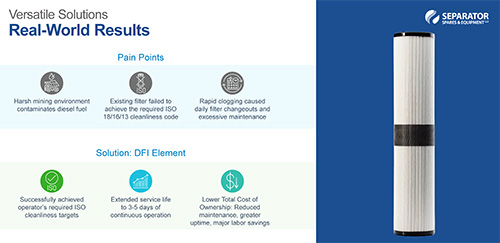 A large-scale mining operation struggled with extreme diesel contamination that overwhelmed standard filtration systems. The inability to maintain fuel integrity led to frequent equipment failures and high maintenance overhead.
The Challenge: Existing secondary diesel filters failed to achieve the mandatory ISO 18/16/13 cleanliness code. Rapid particulate loading caused “blinded” filters, necessitating daily changeouts and resulting in excessive unplanned downtime and maintenance.
The Solution: Implementation of DFI Elements (Diesel Fuel Injection Elements), engineered for high-efficiency particulate removal in high-flow environments.
The Results:
– Cleanliness Targets: Consistently met the operator’s required ISO 4406 Cleanliness Code of 18/16/13 target.
– Extended Service Life: Increased filter longevity to 3–5 days of continuous operation, a 300%–500% improvement over previous benchmarks.
– ROI Impact: Significantly reduced labor costs associated with frequent maintenance and lowered Total Cost of Ownership (TCO) through enhanced equipment uptime and injector protection.
Case Study #2: Bulk Fueling Skid (Supply Chain Optimization)
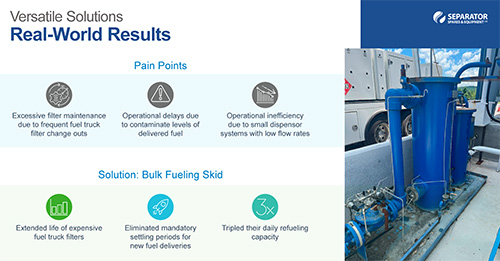 A logistics and fueling facility faced significant throughput bottlenecks due to contaminated diesel fuel deliveries and undersized dispensing hardware.
The Challenge: Contaminant levels in delivered fuel were so high that mandatory settling periods were required before fuel could be dispensed, stalling operations. Furthermore, small, low-flow dispenser systems led to operational inefficiencies.
The Solution: Installation of a high-capacity bulk fueling skid featuring integrated fuel filtration and water separation vessels.
The Results:
– Eliminated Downtime: The high-efficiency system allowed for immediate dispensing, eliminating mandatory settling periods for new fuel deliveries.
– Increased Throughput: The facility tripled (3x) its daily refueling capacity.
– ROI Impact: Drastically extended the life of expensive downstream fuel truck filters by removing the bulk of contaminants at the storage stage.
Leveraging 80 Years of Oil Filtration Engineering Excellence
With over 80 years of specialized engineering expertise, Facet Filtration and Kaydon Filtration remain the global benchmarks for high-performance fuel conditioning. Protecting diesel engines goes beyond selecting the right fuel filtration system; it requires technical expertise and a tailored approach that addresses the specific sources of fuel contamination in your operation.
Investing in Advanced Diesel Fuel Filtration is a strategic move that yields measurable returns:
– Asset Integrity: Prevents the catastrophic failure of high-pressure common rail (HPCR) systems by maintaining fuel cleanliness to ISO 4406 standards.
– Operational Optimization: Eliminates the “reactive” maintenance cycles caused by rapid particulate loading and “blinded” filter elements.
– Environmental & Economic Sustainability: Reduces fuel waste and lowers the Total Cost of Ownership (TCO) through extended service intervals and improved combustion efficiency.
 By partnering with Separator Spares & Equipment, LLC, you gain access to a comprehensive suite of oil filtration solutions, from bulk storage vessels to point-of-use polishing systems, ensuring your diesel fuel, engines, and operations perform at peak capacity. Choosing the right oil filtration system isn’t just about specifications. It is about fit, performance, and long-term reliability.
Water in diesel reduces combustion efficiency, reduces performance, and leads to higher fuel consumption. A tailored diesel fuel water filtration solution aligned with your specific needs will deliver better protection, lower costs, and long-term savings. With a broad range of extremely effective oil filtration systems, Separator Spares & Equipment offers oil filtration solutions to meet your industrial fluid filtration needs. Contact our sales team to help identify the correct diesel fuel filters for your application.
Clean diesel is not an operational expense – it is a strategic investment in the safety, reliability, and productivity of your operation.
Fuel Filtration Frequently Asked Questions (FAQ)
What is the difference between nominal and absolute filter ratings?
Relying on nominal ratings can lead to “particulate bypass,” where contaminants reach the engine despite the presence of a filter. To ensure long-term engine health and compliance with ISO 4406 Cleanliness Codes (such as the 18/16/13 standard recommended by the Worldwide Fuel Charter), always specify absolute-rated elements with a Beta 200 or higher efficiency.
How often should I polish my stored diesel fuel?
Cleanliness is not a one-time metric but a continuous operational requirement. By matching your Beta Ratios to your equipment’s specific protection needs, you move from simply ‘filtering fuel’ to ‘managing reliability’. By utilizing a Kidney-Loop System, you move from reactive ’emergency’ polishing to a proactive strategy that safeguards engine reliability and reduces the Total Cost of Ownership (TCO).
Why is water removal more difficult with biodiesel?
Biodiesel can hold up to 10 times (10x) as much water as standard petroleum diesel, increasing the risk of microbial growth and corrosion.
What ISO cleanliness code should I aim for?
The Worldwide Fuel Charter recommends a minimum standard of 18/16/13 for modern diesel engines to protect components and maintain warranties. This code quantifies the number of particles present in the diesel fuel after filtration across three specific micron sizes (4µm, 6µm, and 14µm). While 18/16/13 is the minimum baseline, mission-critical operations often aim for even higher purity levels to maximize asset life.