Cathodic Protection

Separator Spares & Equipment, LLC is an Authorized MME Group Distributor, supporting customers across the marine, offshore, and industrial sectors. Materiaal Metingen Europe BV, also known as MME Group, is a market leader in cathodic protection, impressed current cathodic protection (ICCP), impressed current anti-fouling (ICAF/MGPS), sacrificial anodes (aluminum anodes, zinc anodes), and boarding equipment. MME Group delivers proven technologies that address corrosion protection, biofouling, and safe access challenges in demanding operating environments.
Cathodic Protection Systems
Materiaal Metingen Europe BV, also known as MME Group, is a market leader in marine and offshore asset cathodic protection and boarding equipment. Its core technologies include impressed current cathodic protection (ICCP), sacrificial anode systems, and impressed current anti-fouling (ICAF/MGPS). All MME Group cathodic protection products and solutions are developed with a strong focus on durability, performance, and lifecycle value.
Reliable and Trusted Impressed Current Cathodic Protection Systems
Corrosion attack is one of the largest threats to the long-term integrity and profitability of assets. Ships, offshore rigs, offshore wind turbines, harbor installations, floodgates, and other marine structures require effective protection against corrosion. This should therefore be made a priority during planning, engineering, production, and operation of these assets. Choosing the cathodic protection method depends on factors such as the structure’s size, material, coatings, environmental conditions, and the required level of protection. Failing to do so could negatively impact your return on investment because of increased maintenance costs.
Cathodic Protection
Protection for the Ship Hulls

Sacrificial Anodes
Sacrificial anodes are part of a cathodic protection system and are attached to a steel structure to protect it against corrosion. Sacrificial anodes are made of a more active, less noble metal (usually zinc or aluminum) than that of the structure itself. When both are immersed in an electrolyte such as seawater, the anodes slowly dissolve, protecting the structure against corrosion attack.
Impressed Current Anti Fouling (ICAF)
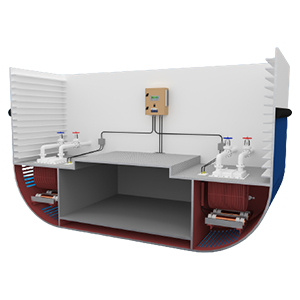
Marine fouling in seawater cooling systems threatens the performance of ships and installations. Removal of marine growth in a ship’s seawater lines also leads to increased cost and delays during maintenance. To reduce this risk, MME Group developed the Marine Growth Prevention System (MGPS), also known as Impressed Current Anti-Fouling (ICAF).
ICAF/MGPS systems use copper anodes that are connected to a compact control unit. The cathodic protection current is applied to the anodes, releasing a small amount of copper ions into the water flowing through the ship’s seawater system or sea chests, creating an environment that prevents the settlement of microorganisms.
Impressed Current Cathodic Protection (ICCP)
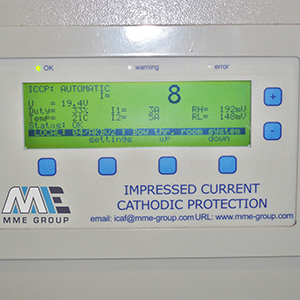
Impressed current cathodic protection (ICCP) systems consist of one or more reference electrodes and several ICCP anodes, which are all connected to a power unit. The reference cells measure the underwater electrical protection potential, and based on this data, the power unit regulates the required anode output. The resulting impressed current prevents the corrosion process from taking place. These advanced systems enable real-time monitoring and ensure the required protection level at all times. A correctly installed, operated, and serviced ICCP system can function for 25 years or more. We can configure ICCP systems using standard components or develop a custom-built solution for specific vessels or structures.
How do sacrificial anodes work?
Marine structures are predominantly made of steel. This makes them highly susceptible to corrosion. Seawater acts as an electrolyte, which causes a transfer of electrons from the steel structure through oxidation. If not dealt with, this process of gradual material reduction can degrade the structural integrity to the point of failure.
Besides coating, the standard protection method is the use of sacrificial anodes. These are made of a more active or less noble metal (usually zinc or aluminum). The sacrificial anodes are attached to the steel structure and since they oxidize more easily, they turn the structure itself into a cathode. The electrons leave the structure through the anodes which slowly dissolve. Applying this physics principle protects the steel structure against corrosion.
What is the difference between aluminum and zinc anodes?
Aluminum has a higher potential difference with other metals than zinc. We recommend aluminum anodes in fresh water because fresh water has a higher electrical resistance than salt water. In saltwater, both aluminum and zinc anodes are suitable.
What kind of zinc is used for MME Group anodes?
MME Group anodes meet the U.S. Military A18001K specifications. This composition of zinc anodes is the result of more than forty years of studies and experiments conducted by corrosion scientists.
Downloads
Similar Products