
Why Oil Varnish Removal Matters
What is varnish in oil?
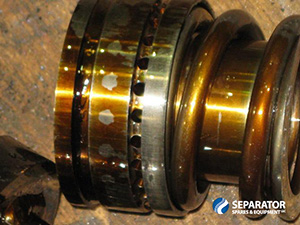 Varnish in oil results from oil degradation and reduced fluid solubility, forcing dissolved contaminants to solidify and plate out on internal metal surfaces. Oil varnish can cause sticking and malfunction in close-clearance moving parts. Varnish binds particulate filters prematurely and clogs narrow oil passages. Oil varnish acts as a thermal barrier on heat exchangers and coolers, raising system temperatures and accelerating further fluid breakdown. Varnish increases friction and wear, accelerating mechanical wear, component degradation, and unscheduled downtime in turbines, engines, and industrial hydraulic systems.
Oil varnish can range from soft, tacky films to hard, lacquer-like coatings, depending on its composition, operating conditions, and degree of aging. Oil varnish is a film that forms on internal equipment surfaces, such as servo valves, bearings, oil filters, rotating equipment, and heat exchangers, when lubricants chemically break down over time. Preventing varnish in oil requires eliminating the root causes of oil degradation and continuously removing soluble precursors before they plate out onto metal surfaces. Because standard mechanical filters cannot trap dissolved molecules, a successful strategy combines environmental controls with specialized kidney-loop filtration.
Oil Varnish Prevention | Oil Varnish Mitigation | Oil Varnish Removal
What causes varnish in the oil?
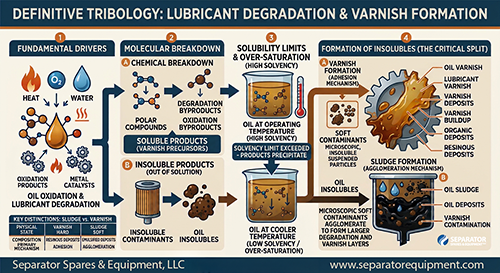 Chemical Degradation (Creating the Precursors)
Several stresses break down the base oil and its additives into sticky, polar byproducts:
- Thermal Degradation and Oxidation: High operating temperatures and localized hot spots cause the oil to react with oxygen. This rapidly consumes protective antioxidants and turns stable hydrocarbons into corrosive acids and resins.
- Micro-Dieseling: When tiny entrained air bubbles move from a low-pressure region into a high-pressure region, they undergo rapid compression. This process, commonly called micro-dieseling or adiabatic compression, can generate extremely high localized temperatures. Under certain conditions, estimated temperatures within the compressed bubbles can reach approximately 800–1,100°C (1,472–2,012°F). These brief, localized thermal events can cause surrounding lubricant molecules to degrade thermally, oxidize, and carbonize, producing carbonaceous deposits and other degradation byproducts that contribute to sludge and varnish formation.
- Electrostatic Discharge: When low-conductivity lubricating oil flows at high velocities through fine filtration media, particularly certain synthetic filter elements, electrical charges can develop through the separation of charges between the oil and filter media. If these charges accumulate faster than they can dissipate, electrostatic discharge can occur when the electrical potential becomes sufficient to overcome the surrounding insulation. These microscopic discharges generate intense localized heat that can thermally degrade the oil and its additives, producing oxidation byproducts and other degradation compounds that contribute to varnish formation. The likelihood of electrostatic discharge increases under certain conditions, including low oil conductivity, high flow rates, and filtration systems that promote charge accumulation.
- Catalytic Contamination: Copper and iron contamination can accelerate oil oxidation by catalyzing chemical reactions that degrade the lubricant. Water contamination also contributes to lubricant degradation, promotes corrosion, and accelerates the depletion of certain additives.
Physical Triggers (Forcing Varnish Out of Solution)
Once degradation byproducts are floating in the oil, specific physical conditions cause them to leave the fluid and coat your machinery:
- Temperature Drops: Warm oil can hold a high concentration of dissolved byproducts. When the machine shuts down, or the oil flows into a cooler zone (like a reservoir wall or heat exchanger), it cools, loses solvency, and deposits sticky residue on metal surfaces.
- Base Oil Formulation: Group II and Group III base oils generally have lower natural solvency for certain polar oxidation byproducts than Group I base oils because of their higher degree of refining and lower aromatic content. As oxidation progresses, these polar degradation products may become less soluble in the lubricant and precipitate out of solution, contributing to varnish formation. However, base oil group alone does not determine varnish tendency. Actual varnish formation depends on the complete lubricant formulation, including base oil composition, additive chemistry, oxidation stability, operating temperature, contamination levels, and the oil’s ability to maintain oxidation byproducts in solution.
- Additive Depletion and Incompatible Mixing: As antioxidants and other protective additives are consumed, the oil becomes more vulnerable to oxidation and degradation. Mixing incompatible lubricants can also disrupt additive chemistry, potentially causing precipitation, sludge formation, or reduced lubricant performance.
Curing (Hardening Into Lacquer)
- Baking Onto Surfaces: Once soft, tacky degradation products adhere to metal surfaces; continued exposure to heat and oxygen can drive further chemical reactions and aging. Over time, these deposits can harden, darken, and become harder to remove, eventually forming lacquer-like coatings.
Oil Varnish Prevention | Oil Varnish Mitigation | Oil Varnish Removal
What can be done to prevent oil varnish?
Preventing varnish requires eliminating the root causes of oil degradation and continuously removing soluble precursors before they plate out onto metal surfaces. Because standard mechanical filters cannot trap dissolved molecules, a successful strategy combines environmental controls with specialized kidney-loop filtration.
Control System Conditions (Stop Precursor Creation)
- Manage Operating Temperatures: Keep bulk oil temperatures within OEM limits and check heat exchangers for fouling. As a general rule of thumb, a 10°C (18°F) increase in operating temperature can approximately double the rate of oil oxidation, although the actual rate depends on lubricant chemistry and operating conditions.
- Eliminate Entrained Air: Check pump suction lines for leaks, maintain proper reservoir oil levels, and ensure return lines empty below the fluid surface. Reducing air entrainment helps minimize the conditions that can contribute to micro-dieseling, particularly in high-pressure hydraulic systems.
- Keep the Oil Dry: Use desiccant breathers on reservoirs and immediately repair leaking cooler seals. Moisture acts as a catalyst, speeding oxidation and additive depletion.
- Prevent Electrostatic Discharge: Use appropriately designed, low-charging filter elements; maintain proper electrical bonding and grounding; and evaluate oil filtration arrangements that may promote charge accumulation. These measures can help reduce the risk of electrostatic discharge and associated thermal degradation of the lubricant.
Deploy Specialized Filtration (Remove Existing Precursors)
Standard particulate filters capture suspended solid contaminants, but they generally cannot remove varnish-forming compounds that remain dissolved in the oil. An offline kidney-loop filtration system equipped with specialized media can help reduce these compounds and capture soft contaminants while the equipment continues operating. Specialized adsorption and ion-exchange technologies address certain dissolved varnish-forming compounds.
- Ion-Exchange Resin Media: These specialized media use adsorption and ion-exchange mechanisms to remove certain polar, dissolved oxidation byproducts from lubricating oil. By reducing varnish-forming compound concentrations in the oil, they can help minimize deposit accumulation on internal equipment surfaces. Removal effectiveness depends on the resin chemistry, lubricant formulation, and operating conditions.
- Depth Media and Electrophysical Separation: Specialized cellulose depth media and electrostatic oil cleaners can capture suspended soft contaminants and fine insoluble degradation products. In cooled depth-media systems, a controlled side-stream of oil is cooled before filtration. Lowering the temperature can cause some dissolved oxidation byproducts to become insoluble, allowing the depth media to capture the resulting particles and agglomerates. Performance depends on oil chemistry, temperature, media characteristics, and system operating conditions.
Optimize Lubricant Management
Specialized adsorption and ion-exchange technologies address certain dissolved varnish-forming compounds.
- Increase Oil Solvency: Certain synthetic base stocks, including selected ester formulations, may provide improved solvency for polar oxidation byproducts. However, changing lubricant chemistry requires evaluation of OEM requirements, lubricant compatibility, seal materials, additive chemistry, and operating conditions. Any lubricant change should be approved for the specific application.
- Avoid Oil Incompatibility: Never top off a reservoir with a different brand or formulation without compatibility testing. Mixing incompatible additive packages can shock the fluid and cause immediate precipitation.
- Monitor with Targeted Oil Analysis: Monitor turbine oil varnish potential using Membrane Patch Colorimetry (MPC), ASTM D7843, which evaluates insoluble lubricant-generated contaminants collected on a membrane patch. Complement this testing with RULER analysis, ASTM D6971, to assess remaining antioxidant activity. Trending these results alongside other oil-analysis data helps identify lubricant degradation and potential varnish problems before equipment performance is affected.
Remove Varnish Formation + Remove Varnish in Oil = Increase Oil Life
Oil Varnish Removal vs. Varnish Prevention: Understanding the Difference
| Technology | Primary Fucntion |
| Adsorption Media | Captures selected dissolved contaminants |
| Centrifugal Separation | Removes suspended solids and insoluble sludge |
| Depth Filtration | Captures suspended insoluble contaminants |
| Electrostatic Separation | Removes certain suspended polar contaminants |
| Ion-Exchange Resin | Removes certain dissolved polar degradation products |
Oil Varnish Prevention | Oil Varnish Mitigation | Oil Varnish Removal
What are the Benefits of Centrifugal Filter Varnish Prevention?
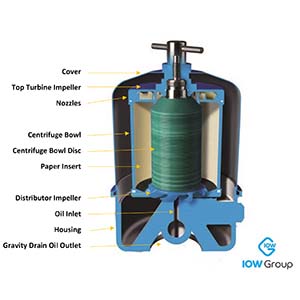 A centrifugal filter functions as a clarifier (clarification). A centrifugal clarifier primarily separates solids from liquid, removing suspended solids from lubricating oil. A centrifugal purifier separates liquid-liquid-solid; it separates free water and solids from oil. The centrifugal clarifier discussed here primarily removes solid contaminants, not dissolved, emulsified, or free water.
The IOW Group MP centrifugal filter functions as a centrifugal clarifier.
A turbine, engine, and hydraulic oil systems will benefit from centrifugal filtration in four (4) targeted ways that directly slow down varnish formation and protect critical components:
Removes Suspended Metallic Wear Debris That Can Accelerate Oxidation
- Stops Accelerated Oxidation: Fine metallic wear debris, especially copper and iron from bearings, gears, and coolers, acts as a powerful chemical catalyst that speeds up oil oxidation. A centrifugal filter uses thousands of g-forces (gravitational force) to spin out ultra-fine solid particles down to roughly 0.5 to 1 micron.
- Preserves Antioxidants: By removing suspended metallic wear debris, particularly particles containing copper and iron, centrifugal separation can reduce one potential source of catalyzed oxidation. This helps limit one contributor to lubricant degradation and premature antioxidant depletion.
Captures Insoluble Sludge and Precipitated Agglomerates
- Removes Heavy Soft Solids: A centrifugal filter cannot remove varnish precursors fully dissolved in warm oil; they continuously precipitate in cooler turbine/engine/hydraulic system zones (such as reservoir walls or heat exchangers) and clump into heavier, insoluble soft solids (sludge). Centrifugal filters effectively remove insoluble suspended particles, soot, and sludge.
- Helps Reduce the Risk of Servo Valve Sticking: By removing suspended soft contaminants and insoluble agglomerates, centrifugal separation reduces the particle concentration that may migrate into tight-clearance hydraulic servo valves and cause valve sticking or malfunction.
Prevents Electrostatic Spark Discharge
- Eliminates Media-Induced Static: Centrifugal separation avoids the specific triboelectric charging mechanism associated with oil flowing through certain fine synthetic filter media. It can therefore reduce one potential source of electrostatic discharge, although it does not guarantee elimination of electrostatic charging or discharge throughout the lubrication system.
- Media-Free Operation: Because a centrifugal clarifier relies purely on rotational force (centrifugal force) rather than conventional fine synthetic filter media, it avoids the specific triboelectric charging mechanism associated with certain filter elements. This reduces one potential source of electrostatic discharge in lubrication systems, although other sources of electrostatic charging may still exist.
Operates Without Conventional Filter-Element Plugging or Bypass
- Continuous Solids Separation: Unlike conventional mechanical depth filters that capture contaminants within a filter element, a centrifugal filter separator removes suspended contaminants by using centrifugal force. Because it does not rely on a disposable depth-filter element, it avoids the conventional filter-element loading, plugging, and differential-pressure bypass associated with mechanical filtration.
- Maintains Separation Performance Within Operating Limits: A centrifugal filter can continue removing suspended contaminants as they enter the system, provided the equipment remains within its design operating parameters. However, accumulated sludge and solids eventually fill the centrifuge bowl (rotor), requiring periodic cleaning to maintain effective separation. Actual separation efficiency depends on contaminant density, particle size, oil viscosity, flow rate, rotor speed, and equipment design.
- Reduces Dependence on Disposable Filter Elements: By removing certain suspended solids and insoluble sludge without relying on conventional depth-filter media, centrifugal filters can reduce the contaminant loading placed on downstream mechanical filters. This can potentially extend filter-element service life and reduce filter replacement frequency, depending on system conditions and equipment configuration.
Because a centrifugal clarifier separates suspended solids by density, it works best as a preventive measure to control particulate contamination. It removes suspended metallic wear debris that can contribute to catalyzed oxidation and captures insoluble sludge and other precipitated contaminants before they circulate through critical components. However, centrifugal separation cannot remove varnish precursors that remain dissolved in the oil. If a turbine, engine, or hydraulic system already has elevated levels of dissolved varnish-forming compounds, the centrifugal clarifier should be paired with an appropriate ion-exchange resin system or cooled depth-media filtration to address those soluble compounds.
Centrifugal separation controls suspended contamination and insoluble sludge.
IOW Group has developed a centrifuge filter that serves as both a centrifugal clarifier and a centrifugal purifier. The IOW Group PuriFuge removes particulate matter, sludge, soot, and free water. The IOW Purifuge is the first pressure-driven centrifugal oil filter to operate at 7 bar with integrated water separation technology. It offers the same benefits as a centrifugal clarifier, plus free water removal.
To learn more about IOW Group centriufgal separator designed for oil purification (purifier) , visit IOW Group PuriFuge.
Oil Varnish Removal Systems
 Do you need to remove varnish from turbine oil, engine oil, hydraulic systems, or rotating equipment? Separator Spares & Equipment provides cost-effective varnish removal systems and varnish mitigation systems that extend oil life and positively impact your business. Our specialized industrial oil filtration and purification units are designed to eliminate dissolved, colloidal, and suspended varnish-forming precursors from turbine lubricants, hydraulic oils, and high-load industrial machinery.
Separator Spares & Equipment is an Authorized Donaldson Facet Distributor (formerly Kaydon Filtration and Facet Filtration). Donaldson Facet is a global leader in oil filtration systems. We provide oil filtration systems that operate continuously as a side-loop (kidney loop) while the main equipment is running and/or during an outage, circulating fluid through specialized filtration media without disrupting operations.
Oil Varnish Prevention | Oil Varnish Mitigation | Oil Varnish Removal
Is your power generation plant still using a Bowser 832P oil conditioning system?
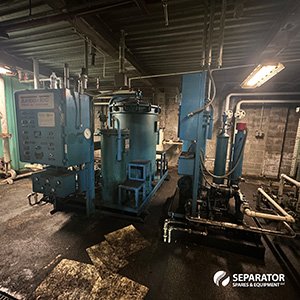 Bowser Inc. was acquired by Keene Corporation and Kaydon/Donaldson Facet. Bowser 832P oil conditioning systems were widely used across the United States until 1985 and shipped to international power facilities until 2005. The Bowser 832P was engineered to condition mineral-based lubricating oils for steam turbines, gas turbines, and combined cycle turbines.
The discontinued Bowser 832P turbine oil conditioner was replaced with the Kaydon-Turbo-TOC System. Contact Separator Spares & Equipment today to replace your power plant oil filtration system. The Donaldson Facet Turbo-TOC (turbine oil conditioning) systems consistently achieve ISO 15/13/11 cleanliness levels and restore turbine oil to “clear and bright” condition, minimizing the risk of varnish formation, bearing wear, and unplanned outages.
The Kaydon Turbo-TOC system provides continuous turbine oil conditioning through particulate filtration and water removal. While controlling moisture and particulate contamination helps reduce conditions that contribute to lubricant degradation and varnish formation, dissolved varnish precursors may require additional specialized treatment, such as the Donaldson Facet KVP Varnish Removal System.
Extend Oil Life By Upgrading Your Turbine Oil Conditioning Systems!