
Definition: Heat transfer occurs via conduction (direct contact), convection (fluid motion), and radiation (electromagnetic waves). In maritime, power generation, and industrial applications, these mechanisms are harnessed through heat exchangers to manage thermal gradients (temperature changes) and ensure operational efficiency.
Mechanisms of Heat Transfer
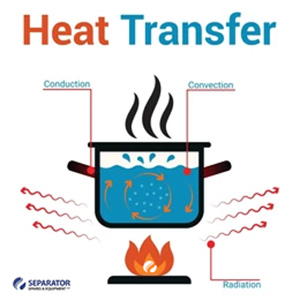 In maritime and power generation, heat transfer is not just a chapter in a thermodynamics textbook; it’s the difference between smooth operation and costly inefficiency. You feel it in the numbers: fuel burn, thermal losses, emissions creeping upward. At its core, the principle is straightforward. The Second Law of Thermodynamics tells us that whenever there’s a temperature difference between two systems, energy will move, always from the hotter side to the cooler one. That simple rule quietly governs everything from engine cooling loops to turbine performance.
Now, how that heat actually moves, that’s where things get interesting. It travels through three (3) primary channels: conduction, convection, and radiation. Each plays a distinct role, and ignoring even one is like leaving money on the table. Conduction handles heat transfer through solid materials; think of metal surfaces in direct contact. Convection steps in when fluids are involved, carrying heat away or toward a surface through motion, whether forced or natural. Radiation is the silent operator, transferring energy through electromagnetic waves, even across empty space.
Real-world systems do not use these mechanisms in isolation. They overlap, interact, and sometimes compete. That is why engineers spend so much time dialing in the right equipment, whether it is a box cooler mounted in a vessel’s sea chest, a shell-and-tube exchanger handling high-pressure duties, or a plate heat exchanger squeezing efficiency out of a tight footprint. The goal is consistent: move as much heat as needed, as efficiently as possible, without pushing materials or operating beyond their limits.
When you get that balance right, the payoff is tangible. Better thermal management improves system stability, reduces mechanical stress, and extends equipment life. It also chips away at fuel consumption and, by extension, emissions. That connection matters more than ever. From keeping a vessel’s onboard environment stable to trimming the carbon output of large-scale power systems, precise control over heat transfer is not just good engineering; it is part of a much larger equation.
Mechanisms of Heat Transfer | Energy is a traveler that never unpacks; it is always in transit from the hot to the cold.
Conduction in High-Efficiency Heat Exchangers
What is conduction?
Conduction is the transfer of kinetic energy from the more energetic particles os a substance to the adjacent less energetic ones as a result of interactions between the particles. Heat conduction can take place in solids, liquids, or gases. In liquids and gases, conduction is due to collisions between molecules during their random motion. In solids, conduction is due to the combination of vibrations of molecules in a lattice and heat energy transport by free electrons.
Conduction is the transfer of energy through a solid material or between objects in direct physical contact.
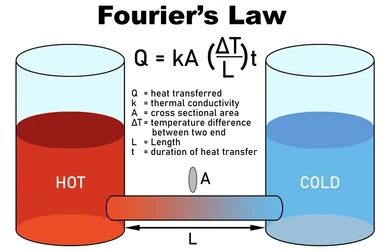
In the maritime industry, this is the primary driver of efficiency in gasketed plate and brazed heat exchangers. Heat energy is transferred via lattice vibrations, and electrons flow through the high-conductivity metal plates. By using materials with high thermal conductivity (k) and minimizing the wall thickness (Δx), manufacturers ensure that heat transfers rapidly from the hot process fluid to the cooling medium.
 Gasketed Plate Heat Exchangers (thin plates, big impact)
Gasketed plate heat exchangers take a simple idea and push it hard: increase surface area (A), and heat transfer follows. These units stack thin, corrugated metal plates, each one shaped to promote turbulence and break up boundary layers. More contact, more mixing, more transfer. It is not complicated, but it is very effective.
The plates themselves are typically stainless steel or titanium, materials chosen for both corrosion resistance and strong thermal conductivity (k). That matters because the faster heat moves through the metal, the less resistance you introduce into the system. In practical terms, you get tighter temperature approaches and better efficiency without needing a massive footprint. There is also a flexibility angle here. You can open the unit, swap plates, and adjust capacity; it is modular in a way many other heat exchanger types are not. Of course, gaskets introduce maintenance considerations. Gaskets age, they wear, they need attention. For many marine and industrial applications, that trade-off is worth it.
Brazed Heat Exchangers (compact, sealed, and pressure-ready)
Brazed heat exchangers strip things down to essentials. No gaskets, no frames, just plates fused together into a single, sealed block. If you have worked around refrigeration systems or high-pressure loops, you have likely seen them tucked into tight spaces where larger equipment simply will not fit.
At the microscopic level, heat moves through the metal via lattice vibrations and free electron movement, a kind of “molecular relay,” if you will. The brazing process bonds the plates into a continuous metallic structure, so there is no interruption in that transfer path. It is efficient, clean, and mechanically strong. You gain durability and pressure tolerance, but you lose serviceability. When fouling builds up or performance drops, you cannot open up the brazed heat exchanger; you have to replace it. In the right application, that is acceptable; in other applications, it is a dealbreaker.
Shell-and-Tube Heat Exchangers (the workhorse that won’t quit)
Shell-and-tube exchangers are the industry’s steady hand. They handle tough conditions, high pressure, high temperature, and variable loads without much fuss. Inside, one fluid flows through a bundle of tubes while another circulates around them within the shell. Heat transfers across the tube walls, plain and simple.
The governing principle here is Fourier’s Law, which relates the rate of heat transfer to material properties, the temperature gradient, and the wall thickness (Δx). And here is where engineering judgment comes in: thinner walls improve heat transfer, but they also reduce mechanical strength. Thicker walls are safer, but less efficient. So you end up balancing competing priorities, thermal performance versus durability. Add in factors like fouling, fluid velocity, and maintenance access, and the design becomes a careful negotiation rather than a fixed formula. When reliability matters most, shell-and-tube units tend to earn their place.
Convection and Fluid Dynamics
What is convection?
Convection is the mode of energy transfer between a solid surface and an adjacent liquid or gas that is in motion, and it involves the combined effects of conduction and fluid motion. The faster the fluid motion, the greater the convection heat transfer (also called forced convection). In the absence of any bulk fluid motion, heat transfer between a solid surface and the adjacent fluid occurs solely by natural conduction (also called free convection). The presence of bulk fluid motion enhances heat transfer between the solid surface and the fluid, but it also complicates the determination of heat transfer rates.
Convection involves the transfer of heat between a solid surface and an adjacent moving liquid or gas.
Convection is the dominant mode of energy transport between moving process fluids and heat-transfer surfaces. In maritime and power generation applications, managing this fluid motion is essential for maintaining optimal engine temperatures.
Natural Convection: Box Coolers (quiet operators below the waterline)
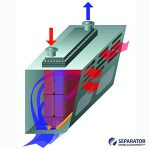 Box coolers are one of those solutions that feel almost too simple until you see how well they work. Mounted directly in a vessel’s sea chest, they keep the cooling process outside the engine room, freeing up space and reducing system complexity. No long piping runs, no extra pumps to move seawater around. At the center of the design is a U-tube bundle submerged in seawater. The sea chest itself is fitted with inlet and outlet grids, allowing seawater to circulate across the tube surfaces. When the vessel is underway, motion through the water creates a natural flow across the bundle, effectively a form of forced convection driven by speed. When the vessel is stationary, the system doesn’t just stop working. Natural convection takes over.
As the seawater around the tubes warms, its density drops slightly, and it begins to rise. Cooler, denser water moves in to replace it. That continuous, passive circulation keeps heat moving away from the system without any mechanical assistance. It’s subtle, almost invisible, but it’s enough to maintain cooling under many operating conditions. Not as aggressive as pumped flow but reliable, energy-free, and low-maintenance. Performance depends on conditions. Warm harbor water, fouling on the tubes, and restricted flow through the grids can all reduce effectiveness. To reduce this risk, it is recommended to use a Marine Growth Prevention System (MGPS), also known as Impressed Current Anti-Fouling (ICAF).
Marine Growth Prevention Systems (MGPS), or Impressed Current Anti-Fouling (ICAF), use copper anodes and a compact control unit that precisely regulates the current output. When energized, the system releases controlled levels of copper ions into the seawater flowing through piping, sea chests, and cooling circuits. This creates an environment that inhibits the settlement and growth of marine organisms such as barnacles, mussels, and algae, thereby helping maintain optimal flow conditions, improve thermal efficiency, and reduce maintenance requirements over the asset’s life.
Forced Convection: Plate Heat Exchangers and Shell-and-Tube Exchangers (turning up the velocity)
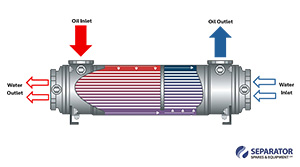
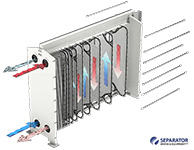 In plate heat exchangers and shell-and-tube exchanger designs, pumps are used to maintain high fluid velocities (V). As the velocity of the fluid increases, the convection heat transfer coefficient (ℎ) rises, significantly enhancing the total heat transfer rate (Q̇conv).
 Q̇conv).
When you need more control, or simply more heat transfer, you step into the world of forced convection. Plate heat exchangers and shell-and-tube units rely on pumps to maintain fluid flow at higher velocities. That velocity is not just about flow rate; it directly impacts how efficiently heat is transferred. Here’s the relationship that matters: as fluid velocity increases, turbulence builds. That turbulence disrupts the thermal boundary layer, the thin film of fluid that resists heat transfer at the surface. Break that layer down, and the convection heat transfer coefficient (ℎ) climbs. When that happens, the overall convective heat transfer rate (Q̇conv) increases accordingly.
The higher velocity means higher (ℎ), and ultimately, more heat is moved per unit time. Pushing the velocity too high increases the pressure drop, which increases the pump’s energy consumption. It can also accelerate erosion in certain conditions, especially with abrasive fluids. It is a balancing act. Engineers tune flow rates to sit in that sweet spot, where heat transfer is strong, but energy costs and wear stay under control. Whether it is the quiet circulation of a box cooler or the controlled intensity of a pumped system, convection is not just about moving fluid; it is about managing energy with intent.
Thermal Radiation and Surface Temperature Properties
What is radiation?
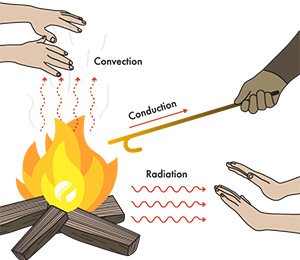 Radiation is the energy emitted by matter in the form of electromagnetic waves (or photons) as a result of the changes in the electronic configuration of the atoms or molecules. Unlike conduction and convection, the transfer of heat energy by radiation does not require the presence of an intervening medium. Radiation differs from other forms of electromagnetic radiation, such as X-rays, gamma rays, microwaves, radio waves, and television waves, which are not related to temperature. All bodies at a temperature above absolute zero emit thermal radiation.
Radiation is the most unique mechanism because it requires no intervening medium.
While often overshadowed by fluid-to-fluid heat transfer, thermal radiation remains a factor in high-temperature power-generation environments. Engineers manage this by considering the emissivity (ε) of equipment casings. Proper insulation and surface treatments serve as thermal barriers, ensuring radiant energy remains within the system rather than dissipating into the engine room or plant floor, thereby protecting both personnel and equipment.
It comes down to how well you manage heat when everything is running under pressure, literally and operationally. The strategic use of conduction, convection, and radiation is what separates systems that just “run” from systems that consistently perform without draining resources. Whether you are dealing with the quiet, space-efficient natural convection inside a box cooler, the high-energy, pump-driven flow inside a shell-and-tube heat exchanger, or the tightly packed, high-surface-area design of a gasketed plate heat exchanger, the underlying goal stays the same: move heat efficiently, keep temperatures in check, and avoid unnecessary stress on the system.
Mechanisms of Heat Transfer | Heat doesn’t respect boundaries; it only looks for the path of least resistance.
 Separator Spares & Equipment, LLC is a leading supplier of complete separation, oil filtration, and heat transfer packages. The woman-owned company has grown from a spare parts provider to a thriving, reliable, global supplier of spare parts and engineered equipment. Serving maritime, power generation, oil and gas, and industrial markets, Separator Spares & Equipment is known for its reliability, technical expertise, and commitment to helping customers reduce downtime and maintain peak system performance.
Separator Spares & Equipment is committed to providing high-performance heat transfer products that deliver a positive impact on your bottom line. We offer industry-leading heat exchanger solutions backed by deep technical expertise and a comprehensive range of equipment. Our portfolio includes a variety of heat transfer technologies designed to optimize thermal energy efficiency and manage demanding temperature requirements. These cost-effective systems are engineered to maximize equipment uptime, lower the total cost of ownership, and significantly reduce energy consumption across marine, power generation, and industrial applications.
Mechanisms of Heat Transfer | Heat never stays put; it just finds a new way to move.